Here’s Why DLS method is Still the Best System to Decide a Cricket Match

It happens so repeatedly that you can consider this as a trend. A crucial match is affected by the rain showers and our much maligned Duckworth–Lewis–Stern method, popularly known as DLS method comes into play. Cricket fans see calculations of win and defeat scenario of their team and they call it absurd. A good example of this can be the semifinal clash between India and New Zealand at Manchester. In the match that was affected due to rain, New Zeland could bat for only 46.1 overs with a loss of five wickets. Now by DLS method, the scenarios for India were as follows:
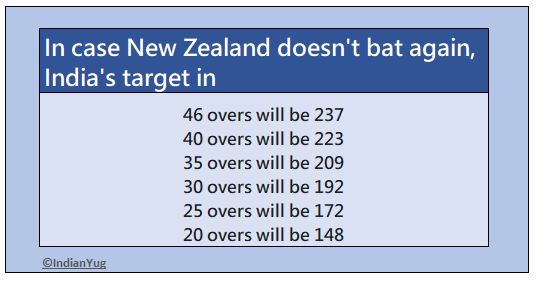
Indian fans were critical as in 20 overs the chase would have been of more than 7 runs per over. Considering New Zealand never reached a run rate of the 5 runs per over throughout the match, is the DLS calculation unfair?
Unlike some other popular sports, cricket is not meant to be played when it is raining or the ground conditions are wet. It is not difficult to guess why, bowlers can’t grip the ball, fielders have chances of injury while they slip or dive and even the cricket ball will stick to the pitch with spongy bounce.
In a bilateral series, the matches being washed out is still not a big problem but in a knock-out scenario, it is really a big deal. The ICC has to make all efforts to ensure that an international tournament ends with a winner. Also, that critical matches at group stages or semifinals have a decider on the field, not on the basis of points. Considering the fact that a tournament like ICC Cricket World Cup happens once every four years. Even as a fan you wouldn’t want a ‘no result’ world tournament. So what is the solution?
The solution lies in Mathematics and Statistics
To overcome this problem, various different methods have been used in the past to resolve rain-affected cricket games, with the most common being the Average Run Rate method and the Most Productive Overs method.
These earlier methods had serious flaws that meant they often resulted in unfair new revised target scores that altered the balance of the match and were easily exploitable.
- The Average Run Rate method did not take into account the number of wickets lost by a team batting second, but simply considered how quickly they were scoring when the match was interrupted. So if a team felt a rain stoppage was likely, they could attempt to force the scoring rate without regard for the corresponding highly likely loss of wickets, skewing the comparison with the first team.
- The Most Productive Overs method also took no account of wickets lost by the team batting second and effectively penalized the team batting second for good bowling by ignoring their best overs in setting the revised target.
An Incident that brought sophisticated Duckworth- Lewis Method of calculation
It was the world cup of 1992 and a rain interruption resulted in applying rain-rule prevalent at that time leading to the elimination of deserving South Africa from the contest. In its first-ever World Cup, the side trotted to the semifinals and was well in the hunt to clinch its target of 253 in 45 overs. Needing just 22 runs from 13 deliveries, the South Africans were forced to endure a rain-break that proved to be fatal. At resumption, the side needed 21 from one delivery, turning what would have been an exciting climax to an anti-climax.
Unlike popular belief it was not DLS method that led to the elimination of South Africa from 1992 world cup, it was the “most productive over” method
The results of the match faced a lot of criticism and there was a reanalysis of the contentious rain rule which ended in the introduction of the Duckworth-Lewis (now Duckworth-Lewis-Stern) method.
How does DLS system work
DLS method simply overcomes the shortcomings of its predecessors. It considers two vital resources for a team, which decides the winnability of a cricket team. These two resources are the number of balls remaining and the number of wickets left, in DLS the target of the second innings is adjusted proportionally to the change in the combination of these two resources.
As in the example of India vs New Zealand match you can clearly see that it is significantly easy for India to chase a target in a lesser number of overs with all 10 wickets in hand. For example which scenario would you accept to play 16 runs in two overs or 400 runs in 50 overs? You clearly know the answer, don’t you, but the run rate is 8 in both the cases.
However, with 10 wickets in hand, it is very easy to score 16 runs in 2 overs and most like the team batting second will easily win. The same can’t be said about 400 runs in 50 overs, even with all wickets in hand.
Mathematical Calculation of DLS Method
The DLS method converts all possible combinations of balls and wickets left into a combined resources remaining percentage figure (with 50 overs and 10 wickets = 100%), and these are all stored in an openly published table or computer.
The target score for the team batting second (‘Team 2’) can be adjusted up or down from the total the team batting first (‘Team 1’) achieved using these resource percentages, to reflect the loss of resources to one or both teams when a match is shortened one or more times.

Why DLS Method is still the best system to decide a cricket match?
This method actually takes care of the variables which can practically be calculated like run scored and wickets, while calculating the par score. After the retirements of Duckworth and Lewis, Professor Steven Stern became the custodian of the method and it was renamed to its current title in November 2014.
DLS method is also statistically corrected from time to time. Any variable for calculation of par score which can be objectively derived like runs and wicket can’t be considered as of now. For e.g, the team batting first may have some capable batsmen left to give a huge boost to the final score.
This, however, may be called a drawback of the DLS method. But as far as fair objective assessment of par score is concerned DLS methods still is the best system. Can it be further improved, Yes, But can be outrightly rejected by fans? We can’t think of a better solution at the moment, you decide.


