20 Percent Ethanol, 100 Percent Mandate: The Fuel Policy Nobody Voted For

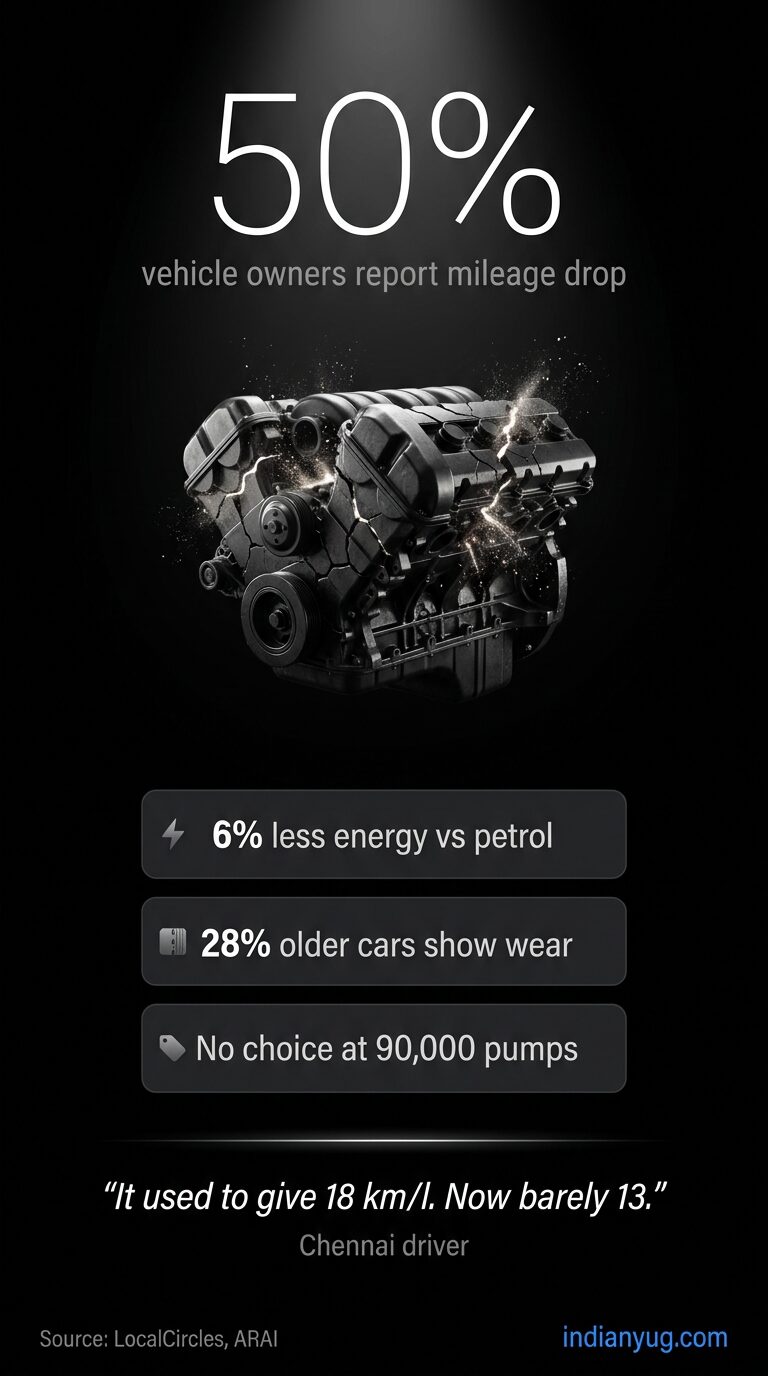
New Delhi: Meenakshi Natrajan, a sales executive in Chennai, used to get 18 kilometers per liter on the highway. After India switched to 20 percent ethanol-blended petrol, that number dropped to 13. She told Deutsche Welle she can feel the car losing power. Her workshop has warned her about injector clogging and fuel pump damage.
She isn’t alone. Across India, millions of drivers report the same thing. Lower mileage. Higher maintenance bills. Engines that feel different. And no way to buy the fuel their vehicles were actually designed for.
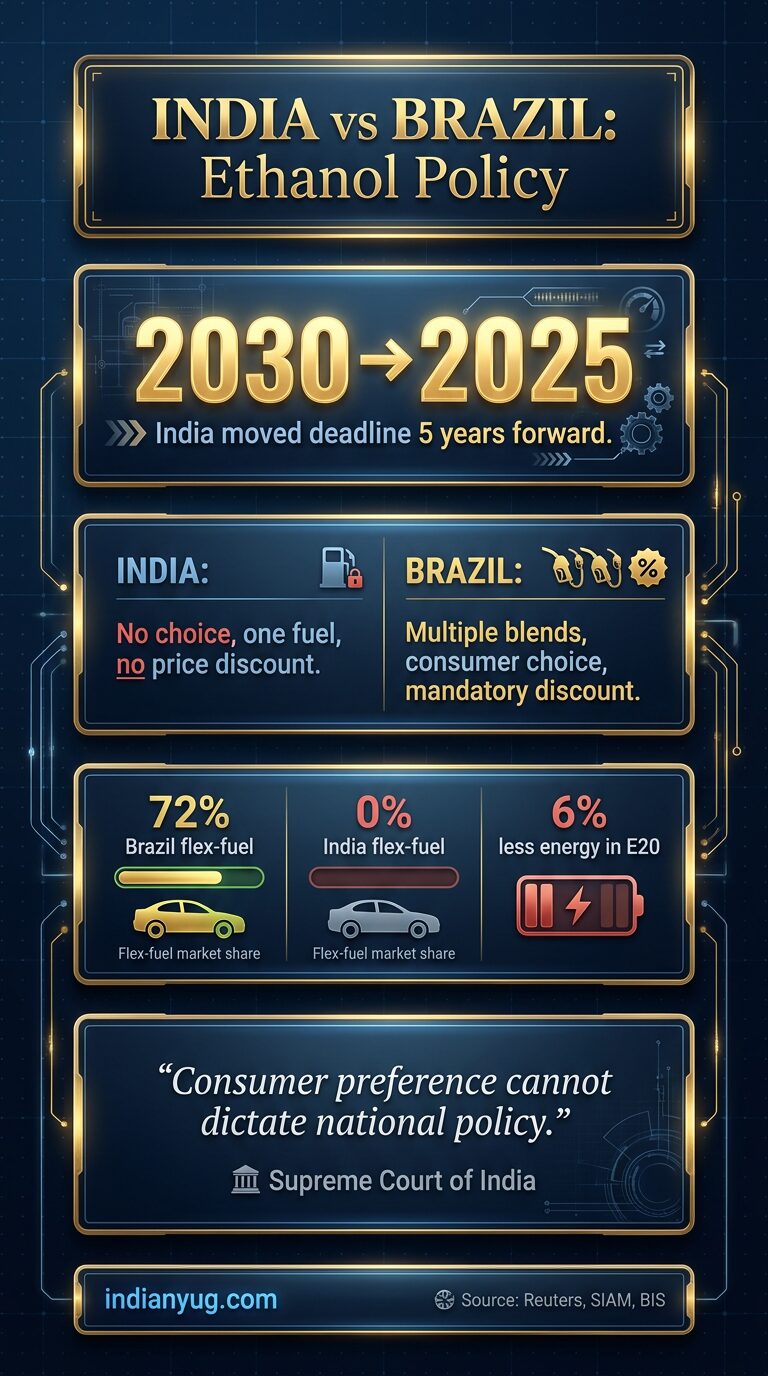
India completed its nationwide rollout of E20 petrol in April 2025. The fuel contains 20 percent ethanol and 80 percent petrol. It’s now the only petrol available at nearly 90,000 fuel stations across the country. The government moved the deadline forward by five years. The original target was 2030.
Here’s what happened. What was sold as a clean energy victory became one of the biggest political flashpoints of the Modi government’s third term. Consumers are angry. The Supreme Court has heard challenges. The Attorney General reportedly called it an “experiment” before walking back the remark. And the government held a 90-minute press briefing on July 4, 2026, to do damage control.
The debate has been polarized. Government channels and pliant media outlets call the concerns misinformation. Social media posts and opposition voices call it a scam. Neither side tells the complete story.
Here is that story.
What E20 Actually Is
Ethanol is a type of alcohol made from sugarcane, maize, or grain. When mixed with petrol, it reduces the amount of crude oil India needs to import. The “E” in E20 stands for ethanol. The number is the percentage.
India started with small blends. E5 meant 5 percent ethanol. E10 meant 10 percent. The jump to E20 doubled the ethanol content in three years. The original plan gave consumers and manufacturers until 2030 to adjust. The government moved that to 2025.
The chemistry is straightforward. Ethanol has a high octane number, around 108 RON, which means it burns cleaner and can improve engine performance in vehicles designed for it. It also has a lower energy density. Ethanol contains about 30 to 35 percent less energy per liter than petrol. When you blend 20 percent ethanol into petrol, the resulting fuel carries roughly 6 percent less energy than pure petrol.
That number matters. It means your vehicle burns more fuel to travel the same distance. The question is how much more, and whether your vehicle can handle it at all.
The Mileage War: Government Numbers vs Real-World Experience
This is where the two sides disagree most sharply.
The Automotive Research Association of India, or ARAI, conducted studies with Indian Oil Corporation and SIAM, the industry lobby group. Their estimate: fuel efficiency would decline by 1 to 6 percent with E20. For E20-compliant vehicles, the government says the drop is just 1 to 2 percent.
Carmakers have admitted to a slightly higher figure in private discussions. Industry sources cited in multiple reports acknowledge a 7 to 8 percent mileage drop on E20.
Then there’s what vehicle owners actually experience.
A LocalCircles survey of 24,710 petrol vehicle owners found that half reported a drop in fuel efficiency in the nine months after E20 became standard. Some reported mileage losses of up to 20 percent. A separate survey cited in academic research found that two-thirds of vehicle owners who bought their cars in 2022 or earlier observed reduced fuel efficiency after switching to E20.
The gap between lab numbers and real roads is striking. Government testing happens under controlled conditions. Real driving involves traffic, weather, load weight, and driving style. Ethanol also absorbs moisture from the air, which can further reduce efficiency in humid conditions common across Indian cities.
The government has dismissed viral social media posts about mileage drops as “click-bait headlines designed primarily to generate online viewership.” Petroleum Minister Hardeep Singh Puri said at a briefing that mileage “may drop a little.” He then compared ethanol to racing fuel, saying “they use it in racing cars also; the acceleration increases.”
Race cars use ethanol for performance, not economy. Their engines are designed for it and rebuilt frequently. The average Indian motorist driving a 2018 Maruti Swift to work every day isn’t in a Formula One race.
The Compatibility Problem: Which Vehicles Can Actually Handle E20
Not all vehicles on Indian roads were built for 20 percent ethanol. This is the core of the consumer backlash.
Vehicles manufactured after April 2023, when Bharat Stage 6 Phase 2 regulations took effect, are required to be E20-compliant. These vehicles have fuel systems designed with materials that can withstand higher ethanol content. Their engine management systems are calibrated for the blend.
The problem? The millions of vehicles sold before April 2023. These were certified for E10, meaning 10 percent ethanol. Many older vehicles were certified for even lower blends.
Ethanol behaves differently from petrol. It absorbs water. It corrodes certain metals. It degrades rubber seals, plastic components, and gaskets that were not designed for it. In older vehicles, this can lead to fuel line damage, injector clogging, fuel pump failure, and compression loss.
Automobile expert Murad Ali Baig told Deutsche Welle that ethanol produces about 30 percent less energy than standard gasoline. He noted that “fuel lines should not have rubber parts that ethanol can dissolve.” The warning is simple: if your vehicle was built for E10, running it on E20 is a gamble.
A study published in the International Journal of Law, Policy and Social Review found that approximately 28 percent of pre-2022 vehicle owners reported unusual levels of wear and tear or repairs in 2025. The affected components included engines, fuel lines, tanks, and carburetors.
What the Government Said, Then Unsaid
The government’s messaging has been inconsistent. This has fueled public distrust.
In June 2026, Attorney General R. Venkataramani appeared before the Supreme Court in a hearing related to E20. Reports emerged that he described the ethanol blending programme as an “experiment” whose results would only be known next year. The remark went viral. It confirmed what many consumers suspected: that the government was testing a policy on millions of vehicles without their consent.
The government quickly denied the characterization. Venkataramani clarified that he was speaking about ethanol supply volumes, not the fuel itself. The Attorney General’s office issued a formal clarification on June 30, 2026, stating that reports claiming the government called E20 an “experiment” didn’t reflect the submissions made before the court.
On July 4, 2026, the government held a press briefing. Senior officials from the petroleum ministry, auto industry representatives, and oil marketing companies took turns dismissing consumer concerns. They called viral complaints “rage bait” and emphasized the macroeconomic benefits of the programme.
The Wire, reporting on the briefing, described it as “a textbook case of damage control.” The 90-minute session left several questions unanswered. How would consumers be compensated for vehicle damage? Why was E10 not retained as an option for older vehicles? What happens when the government moves to E25 or E30?
The government’s answer to the last question is already known. In May 2026, the Bureau of Indian Standards notified IS 19850:2026, covering E22 to E30 blends. The Ministry of Petroleum and Natural Gas mandated that all E20 petrol sold from April 1, 2026 must meet a minimum Research Octane Number of 95. The march toward higher blends is continuing, even as the current blend’s problems remain unresolved.
The Industry’s Two Faces
The auto industry’s position on E20 has shifted in ways that raise questions.
In 2021, SIAM, the Society of Indian Automobile Manufacturers, submitted recommendations to NITI Aayog. The industry body said that “E10 should be made available on a pan-India basis as a protection-grade fuel for the existing pool of vehicles.” SIAM warned of the “mammoth task of developing parts with upgraded material for a large number of vintage variants” and then getting customers to upgrade their vehicles.
These recommendations were overruled. E20 became the base fuel. The rollout date was moved forward.
By July 2026, the same industry was singing a different tune. At the government’s press briefing, Maruti Suzuki’s senior executive officer for corporate affairs, Rahul Bharti, said the company had tested E10-compatible vehicles on E20 fuel and found “nothing of concern.” Hero MotoCorp’s chief business officer, Ashutosh Varma, said analysis of service records had not found a higher incidence of damage. Toyota Kirloskar’s Vikram Gulati called ethanol “a cleaner, high-performance fuel.”
What changed between 2021 and 2026? The policy was decided. The fuel was already in the pumps. The policy was decided. The fuel was already in the pumps. The industry had little choice but to fall in line.
Maruti Suzuki had previously discussed offering E20 upgrade kits for older vehicles. At the July briefing, Bharti said the kits are “only for R&D purposes” and not available in the market. Consumers who were told to wait for a solution are still waiting.
The Choice That Was Taken Away
The most fundamental complaint from consumers isn’t about chemistry or mileage. It’s about choice.
In Brazil, the country India cites as its model, consumers walk into a fuel station and see multiple options. They can choose E20, E27, E100, or pure petrol. Each is priced differently. Brazilian law requires that higher ethanol blends be sold at a discount that reflects their lower energy density. The consumer makes an informed choice.
India took that choice away. E20 is the only petrol available. There’s no E10 option. There’s no ethanol-free option. There’s no price discount to compensate for lower mileage. The Supreme Court dismissed a PIL in September 2025 that sought continued availability of ethanol-free petrol, ruling that “consumer preference can’t dictate national energy policy.”
The court did direct authorities to ensure that consumers are informed about ethanol compatibility of their vehicles at the time of fuel dispensing. Whether this is actually happening at fuel stations across India is questionable.
The Indian Express noted that Indian vehicle owners “didn’t receive blended fuel at a cheaper cost.” The cost savings from ethanol blending, estimated at over $16 billion in foreign exchange over the past decade, went to the national exchequer. The cost of lower mileage and potential vehicle damage went to the individual motorist.
For a daily two-wheeler commuter covering 40 kilometers, even a 3 percent mileage drop means higher monthly fuel costs. For middle-class households already dealing with rising living expenses, this isn’t a small number. The academic study in the International Journal of Law, Policy and Social Review calculated that the cost burden falls disproportionately on lower-income groups who own older vehicles.
The Water Question Nobody Is Answering
The E20 debate has focused on engines and mileage. A more fundamental question has received less attention: where does the ethanol come from?
India produces ethanol primarily from sugarcane. Producing one liter of ethanol from sugarcane can require 2,000 to 3,000 liters of water. Sugarcane and paddy together use 70 percent of India’s irrigation water, according to a NITI Aayog report. It takes 2,500 liters of water to produce one kilogram of sugarcane.
India ranks 13th in the world for overall water stress. It has more than three times the population of the other 17 extremely highly water-stressed countries combined, according to the World Resources Institute. Brazil and the United States, the two countries ahead of India in ethanol production, are classified as low-medium water-stressed nations.
The government is diversifying feedstocks. Grain-based ethanol plants using maize and damaged grains are being promoted. The Grain Ethanol Manufacturers Association argues that modern plants use significantly less process water. But sugarcane remains the dominant source.
VB Kasi, a global commodities trader, told Gas Outlook that the ethanol programme “has to be approached with much caution because sugarcane consumes huge amounts of water, and will lead to scarcity of water in the medium-term.” He suggested that a faster transition to electric vehicles might be a better strategy for a water-scarce nation.
An analysis from CSTEP, an Indian think tank, estimated that meeting the 20 percent blending target would require diverting land roughly seven times the size of New York City to grow biofuel crops. In a country where arable land is already under pressure, this is a significant trade-off.
What Brazil Did Right and India Did Differently
Brazil started its ethanol programme in the 1970s. After the oil crisis. The journey was not smooth. But Brazil did several things India hasn’t done.
Brazil gave consumers choice. Every fuel station offers multiple blends at different prices. Higher ethanol blends are sold at a legally mandated discount. If a Brazilian driver finds that E27 costs more per kilometer than pure petrol, they switch back. The market, not the government, determines the mix.
Brazil invested in flex-fuel vehicles. These vehicles can run on any blend from E20 to E100. By the late 1980s, nine out of every 10 new cars sold in Brazil could run on ethanol alone. Today, 72 percent of Brazilian vehicles are flex-fuel, compared to 10 percent in the United States. India has mandated E20-compliant vehicles for new sales, but hasn’t promoted flex-fuel technology at scale.
Brazil phased its transition over decades. India compressed its timeline from 2030 to 2025. The result is that millions of vehicles designed for E10 are now forced to run on E20 with no alternative.
The government has repeatedly cited Brazil’s success as justification. But it hasn’t adopted the policies that made Brazil’s programme work for consumers. The choice, the pricing mechanism, and the flex-fuel infrastructure that define the Brazilian model are absent in India.
The Legal and Regulatory Gap
The legal framework around E20 in India reveals a significant gap between policy ambition and consumer protection.
The policy relies on executive notifications and voluntary standards rather than legislation. The National Policy on Biofuels, 2018, set targets but didn’t create binding consumer protection mechanisms. The Bureau of Indian Standards sets specifications for fuel quality, but enforcement at the pump level is inconsistent.
Warranty terms are ambiguous. Some manufacturers say their warranties remain valid for E20 use. Others haven’t made clear statements. The government has said E20 use “has no impact on the validity of insurance of vehicles, provided ethanol is BIS-certified.” But if a fuel pump damages your vehicle and you need to prove it was caused by E20, the burden falls on the consumer.
The academic study by advocates Jasmine Sharma and Abhishek Chatterjee proposed a Model Ethanol Blending Bill that would mandate labelling of ethanol content at fuel stations, create transitional dual-fuel provisions, establish warranty and insurance safeguards, and create independent regulatory oversight. None of these proposals have been adopted.
The Supreme Court’s September 2025 dismissal of the PIL against E20 closed one legal door. The court ruled that the policy was well considered and would benefit farmers. But the court’s direction that consumers be informed about ethanol compatibility at fuel stations remains largely unenforced.
What Actually Needs to Happen
The government has said it has no plans to reverse the policy. The fuel industry has fallen in line. The auto industry has changed its tune. The Supreme Court has declined to intervene.
But the problems remain real. And they have solutions that don’t require abandoning the ethanol programme.
First, E10 should be made available as an option at fuel stations, at least for a transitional period. This was the auto industry’s own recommendation in 2021. Brazil offers multiple blends. India can offer two. The cost of maintaining a separate E10 supply is manageable for a fuel distribution system that already handles multiple grades of diesel and premium petrol.
Second, the price of E20 should reflect its lower energy density. If E20 carries 6 percent less energy than pure petrol, the price should be adjusted accordingly. Brazilian law mandates this. India has no such mechanism. The consumer is paying the same price for less energy.
Third, E20 upgrade kits for older vehicles should be made available and affordable. Maruti Suzuki has them in R&D. They should be in the market. The government could subsidize the cost through the savings it has already accumulated from reduced oil imports.
Fourth, fuel stations should clearly display ethanol content and vehicle compatibility information. The Supreme Court has already directed this. Implementation is patchy.
Fifth, the government should publish the ARAI and Indian Oil testing data that supports its claims. The studies that produced the 1 to 6 percent mileage drop estimate were never made public. In a democracy, the data behind a policy that affects 300 million vehicle owners should not be a state secret.
The Reckoning
India’s E20 programme isn’t a mistake. Reducing oil imports, cutting emissions, and supporting farmers are legitimate national goals. The foreign exchange savings are real. The environmental benefits, while debated, aren’t trivial.
But the way the policy has been implemented is a failure of governance. The timeline was compressed. The choice was removed. The costs were transferred to consumers who were not consulted and not compensated. The industry’s own concerns were overridden and then forgotten. The testing data was not shared. The upgrade kits were not delivered. And when citizens complained, they were told they were spreading misinformation.
A policy that requires every petrol vehicle owner in India to bear the cost of a national energy transition, without offering them an alternative or a price adjustment, isn’t a policy that respects the common man. It’s a policy that treats the common man as a cost center.
The government is already planning to move beyond E20. Standards for E22 to E30 blends have been notified. The experience of the E10 to E20 transition suggests that the next jump will be even harder on consumers unless the fundamental issues of choice, pricing, and compatibility are addressed.
The question isn’t whether India should blend ethanol into petrol. The question is whether the government will let citizens have a say in how that transition happens to their lives, their vehicles, and their wallets.
So far, the answer is no.
Sources
- Reuters, “India seeks to quell public backlash on ethanol-mixed fuel after ‘experiment’ remark,” July 3, 2026
- The Wire, “E20 Fuel: Six Unanswered Questions After Modi Government’s Staged Press Conference,” July 2026
- Autocar India, “Govt attempts to quell heightened E20 backlash with industry support,” July 6, 2026
- Deutsche Welle, “Is India’s E20 fuel rollout damaging engines?” September 1, 2025
- The Indian Express, “Why mileage-obsessed Indian motorists are resisting the ethanol mandate,” July 2026
- Live Mint, “Half of petrol vehicle owners experienced lower mileage after ethanol blending, finds survey,” May 2026
- International Journal of Law, Policy and Social Review, “Towards a common man-friendly E20 policy in India,” Vol. 7, Issue 4, 2025
- Gas Outlook, “Biofuels in India will turn water tables dry,” 2023
- NITI Aayog, “Roadmap for Ethanol Blending in India 2020-25”
- Press Information Bureau, Government of India, E20 fuel policy clarifications, 2025-2026
- LocalCircles survey of 24,710 petrol vehicle owners, 2025-2026
- Center for Science and Environment, New Delhi
- Bureau of Indian Standards, IS 19850:2026 (E22-E30 blends)
- Supreme Court of India, dismissal of PIL against E20 petrol policy, September 2025
- World Resources Institute, global water stress rankings


