The Modi Awards: A Four-Day Certificate, AI Errors, and 34 Honours

New Delhi: The Seychelles sun was warm, the cameras were rolling, and Narendra Modi was beaming. Around his neck hung a gold medallion on a ribbon of blue and green. In his hands, a certificate. The title: “Guardian of the Blue Horizon.” The president of Seychelles, Patrick Herminie, had just conferred upon India’s prime minister the island nation’s “highest” presidential distinction.
It was June 28, 2026. The award had been approved by the Seychelles cabinet four days earlier. Modi was its first — and so far, only — recipient.
Within hours, the certificate got dissected frame by frame on social media. “Republic” was spelled “Repubblic.” “Seychelles” appeared as “Seycheeles.” The Latin word OPUS on the official seal was rendered OPVS. When run through OpenAI’s verification tool, the image carried a SynthID watermark — a digital fingerprint that strongly suggested AI generation.
“For an award this prestigious, you’d think they’d at least spell the country name right,” Supriya Shrinate, Congress politician, wrote on X. “They were in such a tearing hurry that they even got the official name wrong.”
The BJP called it a “proud moment for India.” Modi said the award was for “green leadership.”
The questions were already outracing the answers. Neither the Ministry of External Affairs nor the Seychelles State House published the citation on their official websites. No one could independently verify whether the version circulating online matched the certificate the prime minister actually received.
And this wasn’t an isolated incident. It was the latest entry in a pattern that quietly defined Narendra Modi’s foreign policy for over a decade.
Awards Invented for One Man
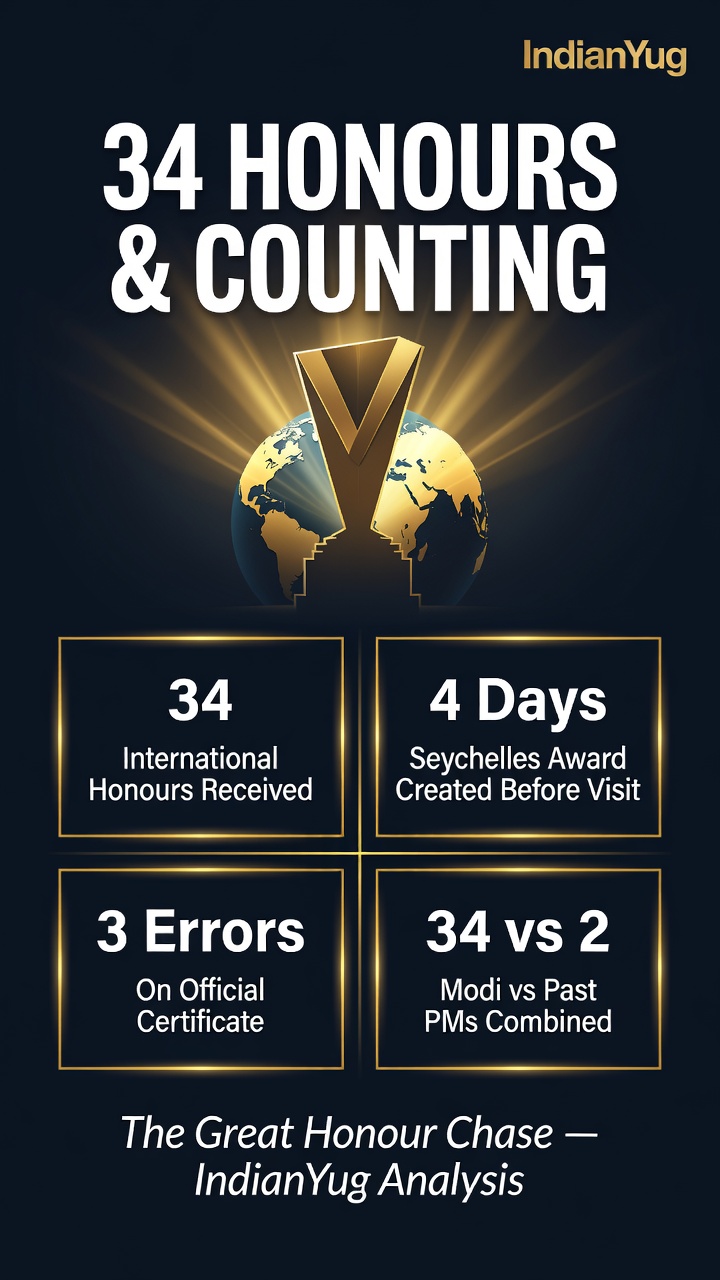
By mid-2026, Narendra Modi has received 34 international honours from foreign nations — more than any Indian leader in history. More than every previous prime minister combined.
The number itself isn’t the story. The story? How they’re obtained.
In February 2026, days before Modi’s visit to Israel, the Knesset Speaker Amir Ohana announced a new award — the “Medal of the Knesset.” Until that moment, it had never existed. No committee had approved it. No regulations. Nothing. The Israeli opposition called it a “non-existent medal.” Dov Khenin, a Knesset member, told Middle East Eye: “What we see in recent times in the Knesset is the total departure from the basic rules and traditions… The non-existent medal to Modi is just one more example of this.”
Indian headlines the next morning read: “PM Modi conferred with Israel’s highest parliamentary honour.”
In 2019, Modi became the first and only recipient of the “Philip Kotler Presidential Award,” described as a global honour for outstanding leadership. The award’s website went dormant. No other leader has received it. Professor Philip Kotler endorsed the honour publicly — but why it was created exclusively for Modi and then never given again, nobody asks.
In 2025 alone, Modi collected: Ethiopia’s “Great Honour Nishan” (first foreign head of state), Trinidad & Tobago’s “Order of the Republic” (first foreign leader), Brazil’s “Grand Collar of the National Order of the Southern Cross” (highest), Namibia’s “Order of the Most Ancient Welwitschia Mirabilis” (highest), Cyprus’s “Grand Cross of the Order of Makarios III” (highest), Ghana’s “Officer of the Order of the Star of Ghana,” and Oman’s “First Class of the Order of Oman.”
The list reads like a global trophy cabinet. Every single one of these awards shares a common thread: they were created long before the recipient arrived, designed to honour a specific kind of statesman. What makes the recent awards different is that some appear to have been created specifically for the arrival. Not because the nation had a tradition of honouring visiting dignitaries. Because the visit demanded one.
Anatomy of an Ad-Hoc Award
The Seychelles case shows how these awards really get made.
According to the Seychelles State House website, the “Guardian of the Blue Horizon” was approved by the cabinet on June 24, 2026 — a Wednesday. Modi arrived on Saturday, June 27. The award was conferred on Sunday, June 28.
Total time between approval and conferral:
Four days.
The cabinet decision itself was barely detailed — a single line item in the minutes. No public consultation. No parliamentary debate. No established criteria for who qualifies. It was simply created and immediately awarded.
The certificate that accompanied it appeared to have been produced without basic proofreading. The official seal had a Latin motto error. The country’s name was misspelled twice. Detecting a SynthID watermark — a tool OpenAI uses to tag AI-generated images — raised the question of whether the certificate itself was produced using generative AI in a hurry.
When the CEO of a startup has a logo designed on Fiverr the night before a pitch, we call it amateur hour. When a sovereign nation does it for a visiting head of state, we call it — well, most Indian media called it a “proud moment.”
Neither the External Affairs Ministry nor Seychelles State House has released the original certificate for verification. The only version that exists online is the one that went viral for its errors.
Before and After Modi
Official data laid before the Rajya Sabha by the Ministry of External Affairs on July 31, 2025, in response to a starred question, provides the most authoritative comparison available.
| Prime Minister | Foreign State Honours in Office |
|---|---|
| Jawaharlal Nehru (1947–64, 17 years) | 2 |
| Lal Bahadur Shastri (1964–66, 19 months) | 1 |
| Indira Gandhi (1966–77, 1980–84, ~15 years) | 2 |
| Rajiv Gandhi (1984–89, 5 years) | 0 |
| P.V. Narasimha Rao (1991–96, 5 years) | 0 |
| Atal Bihari Vajpayee (1998–2004, 6 years) | 1 |
| Manmohan Singh (2004–14, 10 years) | 1 |
| Narendra Modi (2014–present, 12 years) | 34 |
| Narendra Modi (2014–present, 12 years) | 34 |
(Source: Rajya Sabha Starred Question No. 134, answered by MEA on 31 July 2025; updated to July 2026)
The gap isn’t just numbers. It’s structural.
Nehru’s honours — the Freedom of the City of London and the Freedom of the City of Belgrade — were recognitions of his role as a founding leader of the non-aligned movement. Given years into his tenure. By established institutions with clear protocols.
Modi’s honours operate on a different logic entirely. Timed to visits. Frequently “firsts” — first foreign recipient, first person to receive the award at all. Announced not by independent honours committees but by heads of state who are simultaneously hosting the prime minister for bilateral negotiations.
Diplomacy has a word for this, though it’s rarely spoken aloud: a quid pro quo honour. The host nation gets a photo opportunity, strengthened bilateral ties, economic packages, or defence deals. The visitor gets a medal and a headline.
In Seychelles, the exchange was laid bare in the same visit’s outcomes: 19 bilateral agreements, a USD 175 million Special Economic Package from India, and an award created four days earlier.
— The math writes itself.
What the Awards Actually Buy
Nilanjan Mukhopadhyay, author of a biography of Modi, said it plainly: “The intention behind collecting these awards — often bestowed in circumstances that raise eyebrows — is to convey to supporters and potential converts that Modi is being honoured across the world because of his greatness and that India’s rising clout is because of Modi’s personality.”
This isn’t a fringe view. It’s a description of how the BJP’s electoral machinery uses foreign recognition.
Every new award is fed into the party’s communication ecosystem: a press release from the PMO, a social media post from the official handles, a caption on the NaMo app, a segment on news channels that have carved out entire primetime slots for the prime minister’s travel diaries. The message is consistent and unsubtle: the world respects Modi. If you respect India, you must respect Modi. The two are synonymous.
In a political system where the prime minister’s face dominates every hoarding, every news bulletin, every election campaign — foreign awards serve as third-party validation of the cult. They aren’t for the international community, who largely ignore them. They are for domestic consumption.
The awards get weaponized two ways: first, to insulate Modi from criticism (how can you attack a leader the whole world honours?); second, to delegitimize opponents (the Congress party produced one foreign award for Manmohan Singh in ten years — who’s the world actually respecting?).
Are These Even Legal?
Article 18 of the Indian Constitution prohibits the state from conferring titles. Critically: “No citizen of India shall accept any title from any foreign state.”
The Constitution’s authors remembered colonial honours — the “Sir,” “Lord,” and “Rai Bahadur” titles that the British used to co-opt Indian elites. The Constituent Assembly wanted to ensure that independent India’s citizens would never again derive their status from a foreign power’s recognition.
A distinction exists in Indian law between a “title” (barred) and an “honour” (permitted). The test: can the recipient use a prefix or suffix to their name? Since Modi doesn’t append “Guardian of the Blue Horizon” to his official correspondence, the government’s position is that these are honours, not titles.
The distinction is convenient. And it has never faced a court test at this scale. The question the Constitution raises — and that no opposition party has seriously pressed — is whether accepting 34 honours from foreign states violates the spirit of Article 18. Many were created specifically for one recipient. That violates the spirit of the Article — even if it passes the letter.
The fact that this question is never asked in Parliament is itself a commentary on the state of India’s political opposition.
Silence of the Press
The Guardian’s article — published on July 3, 2026 — was written by a British newspaper about an Indian prime minister. That it took a foreign outlet to produce a comprehensive report on Modi’s award-collecting habit is telling.
Indian media’s coverage of the Seychelles award was a masterclass in looking the other way. The major news networks led with “PM receives Seychelles’ highest environmental honour.” The typos were mentioned as a footnote, quickly dismissed as “a minor error.” The AI-generated certificate was framed as “controversial allegations by opposition.” The fact that the award didn’t exist until four days before the visit wasn’t investigated further.
One channel ran a segment: “Why the world is queuing up to honour PM Modi.” It left out the Knesset medal, the Philip Kotler award that has never been given to anyone else, the Seychelles certificate with spelling errors. Twelve minutes of uninterrupted homage.
This isn’t a failure of individual journalists. It’s structural. In a media environment where the largest news networks face regulatory pressure, where advertising revenue correlates with government goodwill, where “national pride” is a more profitable editorial stance than critical inquiry — the story of how 34 awards were obtained over 12 years isn’t one that gets funded, assigned, or prioritized.
The Question Nobody’s Asking
More awards are coming. Modi has visits planned to New Zealand and other nations. Each will likely produce another medal, another headline, another “proud moment for India.”
But here’s the question no one in the Indian establishment is asking:
What happens when the awards stop?
Not because Modi stops travelling. Because the world eventually notices the pattern. Because host nations stop creating new honours when the diplomatic cost exceeds the benefit. Because a future Indian prime minister inherits a template of foreign visits defined by manufactured recognition — and faces a world less willing to play along.
The Seychelles award may be remembered not as a “proud moment,” but as the moment the pattern became too obvious to ignore. A certificate with spelling errors, generated by AI, created in four days, given to a man who now holds 34 such pieces of paper — none of which he can use as a prefix to his name, but all of which he can use to fill the space between his name and the next election.
Sources: The Guardian (3 July 2026), Middle East Eye (Feb 2026), Newslaundry (29 June 2026), Rajya Sabha Starred Question No. 134 (answered by MEA 31 July 2025), Hindustan Times, The New Indian Express, Wikipedia (List of awards received by Narendra Modi), NDTV, India Today, PMO India, Constitution of India Article 18, Seychelles State House Cabinet Decisions (24 June 2026), Knesset press releases, Nilanjan Mukhopadhyay (Modi biographer), Dov Khenin (Member of Knesset, Israel), Supriya Shrinate (INC), Mohammed Zubair, Aroon Deep


