100 Scientists Left ISRO in Months. The Government Just Locked the Door.

New Delhi: In the last few months, while India’s space programme was preparing for its most ambitious chapter yet, something else was happening quietly inside the country’s premier space agency. Scientists were leaving. Not one or two, but in numbers large enough to force the Department of Space to issue an extraordinary order on July 14, one that effectively locks the exit door for anyone working on India’s flagship space missions.
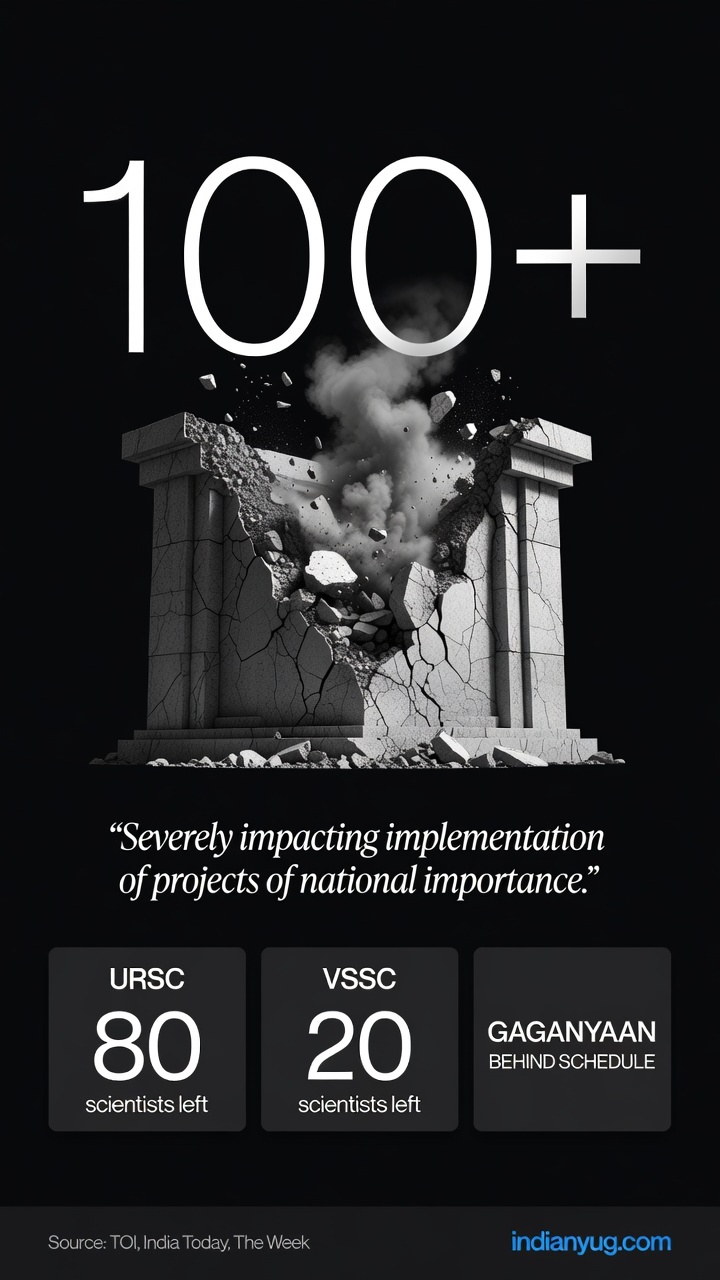
More than 100 scientists and engineers walked out of ISRO between roughly March and July 2026. The bulk of them came from two of the agency’s most critical centres. Around 80 resigned from the U R Rao Satellite Centre (URSC) in Bengaluru, which builds India’s satellites. At least 20 left the Vikram Sarabhai Space Centre (VSSC) in Thiruvananthapuram, where launch vehicles are designed and assembled. Sources who spoke to the Times of India on condition of anonymity said the real number could be closer to 120, with more applications sitting in the evaluation pipeline.
This is not attrition at the margins. These are the people who build India’s satellites, design its rockets, and run the simulations that validate its moon landings.
The order that changed the rules
The Department of Space moved fast. On July 14, it issued an internal memorandum signed by SR Rajashekar, Joint Secretary (Personnel), directly addressing what it called an alarming trend. The language is blunt.
“Of late, it is noticed that there has been a spate of requests for voluntary retirement and resignation from Group ‘A’ scientific/technical personnel including those associated with prestigious Gaganyaan and other important missions/projects severely impacting implementation of projects of national importance.”
The memo tells centre directors and unit heads that resignation and voluntary retirement requests from scientists linked to Gaganyaan and other important missions “may not be accepted as a matter of routine.” Instead, every case must now go to the Department of Space itself, along with the director’s recommendation, for a final decision. Until those projects are complete, the exit door stays shut.
This reverses a key reform from November 2020. Back then, centre directors had been empowered to accept resignations up to the scientist/engineer-SG level. That authority is now effectively withdrawn for anyone working on the country’s most important missions.
Who left and why it matters
The departures include some of ISRO’s most recognisable names. Victor Joseph, the project director of LVM-3, the heavy-lift rocket that will carry Indian astronauts to space, resigned from VSSC. The SpaDeX project director, who was leading India’s space docking experiment, quit from URSC. Aditya Rallapalli, the project manager for simulations on Chandrayaan-3, left too. His team generated nearly 25 terabytes of data from over 1,00,000 simulations to validate the spacecraft’s historic landing on the Moon in 2023.
To understand why these departures hurt, you have to understand what ISRO builds. Skills don’t transfer easily here. A satellite engineer at URSC takes years to learn the specific failure modes, test protocols, and safety margins that come with building spacecraft meant to operate in vacuum for a decade. A launch vehicle designer at VSSC carries knowledge of vibration tolerances, propellant chemistry, and trajectory margins that no textbook teaches. When someone like Aditya Rallapalli walks out, the entire simulation chain takes a hit. Someone else must rebuild that institutional knowledge from scratch, and that takes time ISRO does not have.
The private sector lure
The reason most of these scientists are leaving is not hard to find. India’s private space sector has exploded in the last five years. Startups like Skyroot Aerospace, Agnikul Cosmos, Pixxel, and Dhruva Space are raising hundreds of crores in funding. They need experienced people, and they are willing to pay for them.
A senior ISRO scientist who spoke to The Week on condition of anonymity put it plainly. The salaries and emoluments scientists receive at ISRO, even on prestigious projects, are much lower than what private space firms offer. Many who left have joined private companies as consultants for significantly higher pay packages. “Though the pressure of work exists in space startups as well, some scientists find their roles as external consultants less demanding,” the scientist said.
This tension is not going away. India wants both a strong ISRO and a thriving private space ecosystem. But those two goals compete for the same pool of talent. Every rocket startup that hires an experienced ISRO propulsion engineer solves its own problem while deepening ISRO’s. The government’s memo is a stopgap. It does not address the salary gap, nor does it make ISRO more attractive to young scientists who now have options their predecessors never did.
Not a new problem, but the stakes are higher
Attrition is not new to ISRO. Between 2004 and 2007, nearly half of the agency’s new recruits left. Official figures show about 700 employees resigned between 2012 and 2024. But the scale and timing of the current wave is different.
ISRO’s total workforce stands at about 14,600. URSC had 1,339 employees at the end of the last financial year. VSSC, ISRO’s largest centre, had 4,577. The 100-plus departures represent less than 1 percent of the total headcount. That makes the numbers look small on paper. But the concern is not about how many left. It is about which ones left and when.
India is in the middle of its most ambitious period in space since the 1960s. Gaganyaan, India’s first human spaceflight mission, is already behind schedule. The first uncrewed test flight, HLVM3 G1 or OM1, was slated for the first quarter of 2026 and has not happened yet. Chandrayaan-4, a sample return mission to the Moon, is in advanced planning. A Venus orbiter and Mangalyaan-2 are on the drawing board. The Bharatiya Antariksh Station, India’s own space station, is a stated goal for the next decade.
Each of these missions requires years of accumulated expertise. A propulsion engineer who spent a decade on the CE-20 cryogenic engine for Gaganyaan cannot be replaced in weeks. A guidance specialist who ran the descent simulations for Chandrayaan-3 cannot just hand over a binder and walk out. That knowledge transfers in the doing, over years, through failure and iteration.
Vacancies that tell their own story
The numbers coming out of Parliament paint a fuller picture. On February 11, 2026, Minister of State for Space Dr Jitendra Singh told the Lok Sabha that ISRO’s overall sanctioned strength across science, technology, and administration stood at 18,142. Of these, 2,613 positions were vacant. Recruitment action for 1,449 of those posts was underway.
That is a 14 percent vacancy rate at the country’s most important scientific agency. And the gap between sanctioned strength and filled positions has been widening, not shrinking. The new DoS memorandum addresses the symptom, not the cause. People are leaving not because ISRO is a bad place to work, but because the system cannot match the pull of a booming private sector.
What ISRO’s chairman says
ISRO Chairman V Narayanan acknowledged the departures but moved to contain the concern. “Yes, a lot of people go, but that’s part of every organisation. The move isn’t only to retain, but also to ensure that important projects don’t suffer all of a sudden. If someone is still going, someone else will take responsibility. We’re taking care of it,” he told the Times of India.
He has a point. Organisations do lose people, and ISRO has a deep bench. But the memo itself contradicts his confident tone. If the situation were truly under control, the Department of Space would not have felt the need to reverse a 2020 reform and centralise exit approvals. The memo’s own language about “severe impact” on national projects tells a different story from the public reassurance.
Narayanan also drew attention to what ISRO is doing beyond retention. The agency’s 2025-26 annual report notes that recruitment for more than 1,050 scientific, technical, and administrative posts is at an advanced stage. A cadre review approved last year has regularised 466 project posts and created about 460 higher-grade positions. But these are structural fixes with long lead times. They do not help when a key project director resigns with immediate effect.
The counterargument: Crisis or evolution?
Not everyone sees this as a crisis. Srimathy Kesan, founder and CEO of Chennai-based space startup SpaceKidz, offered a broader view. “As India’s space sector opens up to greater private participation, professionals with expertise in satellite systems, launch vehicles, propulsion, avionics and mission operations are finding a wider range of career opportunities across startups, research institutions, academia and the aerospace industry. Such movement of talent is not uncommon in technologically advanced sectors and often reflects the growth of an entire ecosystem rather than the challenges of a single organisation.”
She pointed to NASA as a comparison, which also sees regular attrition. ISRO, she said, remains one of India’s most prestigious scientific institutions, offering work on nationally significant missions that inspire generations.
There is some truth here. A growing private space industry is better than a stagnant one. More players mean more innovation, more launches, more applications on the ground. But the transition from a single-agency model to a multi-player ecosystem comes with costs, and ISRO is bearing them right now.
The question is whether the ecosystem can grow fast enough to absorb the talent and still leave ISRO with the depth it needs. So far, the numbers suggest the answer is no.
What comes next
The DoS memorandum will slow things down. Scientists who want to leave will now have to navigate central approval, and that is a deterrent. But you can block resignations for a few months, maybe a year. You cannot retain talent by order for a decade.
The bigger question is whether the government will address the structural issues behind the exodus. ISRO’s pay scales are government pay scales. They cannot match what a funded startup can offer. The cadre review is a step, but it took a year to regularise 466 positions against more than 2,600 vacancies. At that pace, the problem runs ahead of the solution.
India is now in a race. It must build its human spaceflight programme, its space station, and its planetary missions, all at the same time, while competing for talent with a private industry it encouraged to grow. The Department of Space can lock the door today. But someone will have to figure out how to make people want to stay.
Sources
- Times of India, “Department of space moves to stem exodus from key Isro missions; at least 100 quit in past few months,” July 16, 2026
- India Today, “Over 100 Isro scientists part of missions like Gaganyaan quit, exit to be tightened,” July 16, 2026
- The Week, “ISRO’s retention crisis: Can a government memo stop ISRO scientists from quitting and joining private rivals?” July 16, 2026
- The New Indian Express, “Nearly 100 ISRO scientists quit; DoS tightens rules to stem exodus,” July 16, 2026
- Economic Times, “ISRO resignations: Govt tightens exit rules for Gaganyaan and other critical projects,” July 16, 2026
- Business Today, “100+ scientists linked to Gaganyaan, other missions quit Isro; DoS puts brakes on resignations,” July 16, 2026
- Parliamentary reply by Dr Jitendra Singh, Minister of State for Space, Lok Sabha, February 11, 2026


