The AI Hallucinated Judgment That Made the Supreme Court Draw a Line

On a regular Thursday in July, a bench of two judges at the Supreme Court of India did something that sounds like a science fiction plot. They struck down a commercial court judgment worth ₹87.43 crore because the ruling had been built on case citations that did not exist.
The references looked real. They had court names, years, page numbers and neutral citations. But every single one of them was generated by artificial intelligence, hallucinated from scratch by a large language model that simply made them up.
What followed was not just a judgment. It was a declaration of war.
The Case That Broke the Camel’s Back
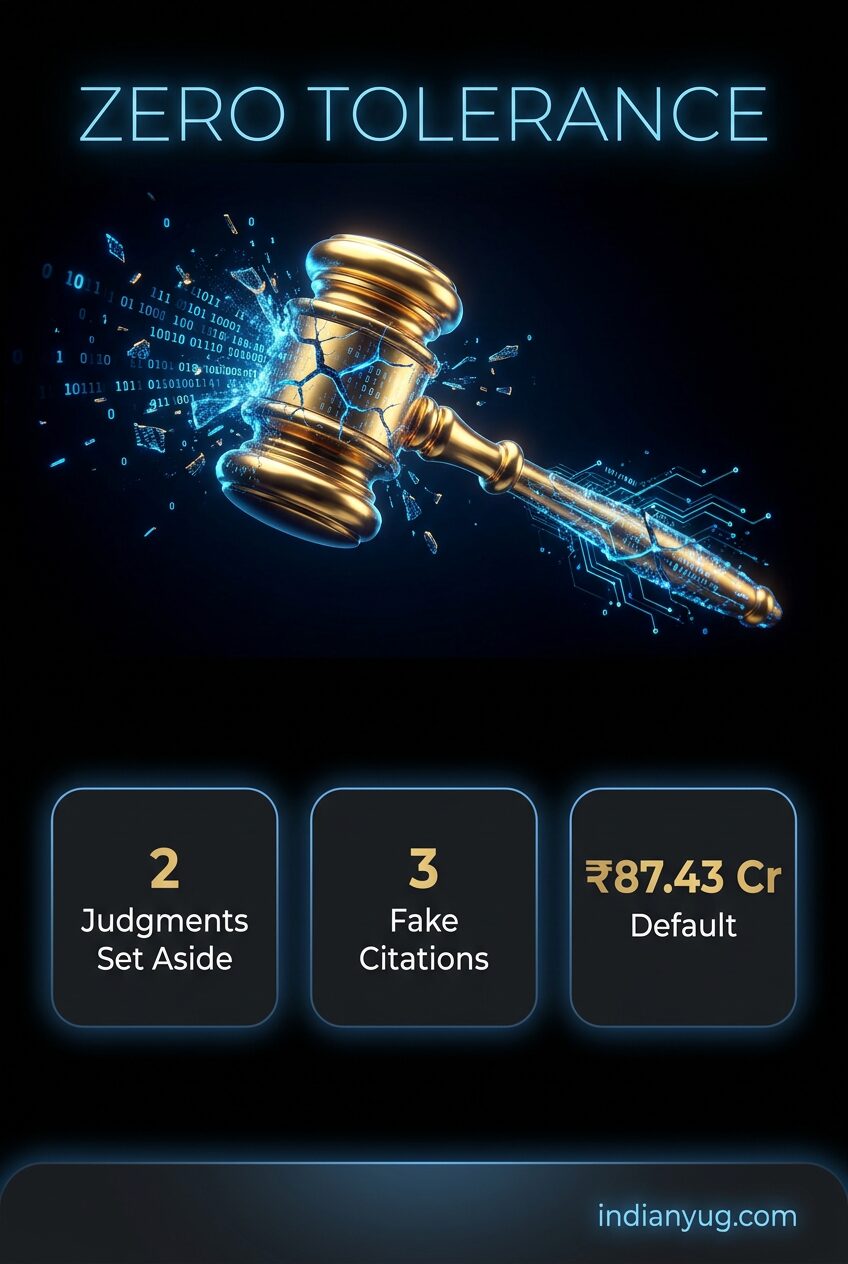
The dispute before the Court was a standard insolvency matter. Jammu and Kashmir Bank had filed a petition under Section 7 of the Insolvency and Bankruptcy Code against Essel Infraprojects Limited, citing a default of ₹87.43 crore.
The National Company Law Tribunal in Mumbai admitted the petition on August 28, 2024, and the National Company Law Appellate Tribunal upheld that order on September 11, 2025.
On appeal, Senior Advocate Madhavi Divan, representing the suspended director Pooja Ramesh Singh, made an extraordinary claim. She told the Supreme Court that the NCLT judgment had relied on six judicial decisions. And several of them did not exist.
The court ordered verification. The result was damning. Three of the cited precedents, including “State Bank of India vs. Shree Ram Urban Infrastructure” (allegedly 2020 SCC OnLine SC 341) and “ICICI Bank vs. Urban Infrastructure Real Estate” (allegedly 2019 16 SCC 528) could not be found in any recognised legal database. They were fabrications, produced by an AI tool and inserted into a judicial order without verification.
To make matters worse, the bank’s counsel filed an affidavit clarifying that they had never cited these cases. The NCLT had found them through what it called “its own research”.
Methyl Isocyanide of Law
Justice Pamidighantam Sri Narasimha and Justice Alok Aradhe did not mince words. In one of the most striking judicial analogies in recent Indian legal history, the bench compared AI-generated fake precedents to the Bhopal gas tragedy.
“For us, that is, for those who are in the province of adjudication and determination of disputes, this byproduct of AI, that is the production of fake, non-existing and hallucinated material and its utilisation as precedent in law, is like the release of methyl isocyanide in the province of law and justice, invisibly insidious and catastrophic by the time anyone notices,” the Court observed.
Methyl isocyanide was the toxic gas that leaked from Union Carbide’s Bhopal plant in 1984, killing thousands. The comparison was deliberate and devastating.
Zero Tolerance Declared
The Supreme Court declared that courts must adopt a “zero tolerance mode” for citing or using AI-generated precedents without verification. The ruling creates three binding principles.
First, any advocate who cites an AI-hallucinated judgment without verifying it commits professional misconduct. The Bar Council of India has been directed to constitute a committee to examine this issue and prescribe disciplinary action.
Second, any judge who relies on AI-generated fake material commits a serious lapse. A decision founded on such material, even partially, is “no decision in the eyes of law”. The Court held that such rulings are liable to be set aside even if only an “iota” of hallucinated material entered the decision-making process.
Third, the Court asserted that while AI can be used to assist adjudication, it can never replace human reasoning. Adjudication must remain under “total and absolute control” of humans at every stage.
Deeper Problem, Wider Implications
This is not an isolated incident. The same bench had earlier flagged a trial court that cited AI-generated fake judgments. The Supreme Court has also published draft regulations on AI use in courts and invited feedback from the bar.
But the systemic problem runs deeper. AI tools are now freely available to lawyers, judges and court staff. A lawyer asking ChatGPT or a similar tool for case law can receive confidently written citations that look authentic but are entirely fabricated. Without mandatory verification protocols, the risk of hallucinated precedents entering the judicial record is real and growing.
The Court was careful to distinguish between using AI as a legitimate aid and relying on its unchecked output. “We are neither concerned with the cause nor the process of resolving such hallucination,” the bench said. “It is for the engineers and scientists to deal with them.”
Landmark Directions
Beyond the specific case, the Supreme Court used this judgment to lay down a framework:
The Bar Council of India must conduct a comprehensive performance audit of its own disciplinary mechanisms. The Court noted “insufficient publicly available information” about whether existing complaint and disciplinary systems are working.
It identified ten factors for this audit, including complaint disposal rates, average timelines, regional variations, staffing adequacy and transparency of proceedings.
The NCLT judgment and the NCLAT order were both set aside. The matter has been remanded to the NCLT for fresh consideration, uninfluenced by the hallucinated citations.
The Other Side
Critics may argue that this ruling creates an additional burden on an already overstretched judiciary. Verifying every citation manually is time-consuming. AI tools, when used responsibly, can speed up legal research dramatically.
The Court acknowledged this tension but held that integrity of adjudication must take precedence over convenience.
Some legal experts point out that the ruling does not address the question of how lawyers and judges are supposed to verify citations in practice. With thousands of cases being filed daily, a practical verification framework will need technology itself perhaps AI-based citation checkers, to implement the Court’s directive effectively.
Reckoning
India’s courts are among the most overburdened in the world. The idea that AI-generated hallucinations could silently enter judicial reasoning and produce binding orders is chilling. The Supreme Court has drawn a clear line. Now the question is whether the legal system has the institutional capacity to enforce it.
The next few months will be crucial. The BCI committee must report back. The draft AI regulations need to be finalised. And every lawyer in the country needs to hear this message loud and clear: if you cite a fake judgment, even by accident, you are committing misconduct. And the judgment you win with it is worth nothing.
Sources
Pooja Ramesh Singh vs. Jammu and Kashmir Bank Ltd. (2026 INSC 668); LiveLaw; The Federal; Verdictum
Source: Pooja Ramesh Singh vs. Jammu and Kashmir Bank Ltd. (2026 INSC 668); LiveLaw; The Federal; Verdictum


