
New Delhi: On July 20, 2026, the cameras at Jantar Mantar didn’t only catch tear gas and plastic roses. They caught something quieter and, in the long run, more serious.
Chest after chest of Rapid Action Force and other security personnel without a name plate.
Not one blurred frame. Not one man in the far background. Large sections of the line. Camouflage. Blue shirts. Riot kit. Faces visible. Names gone.
In Indian protest coverage, this isn’t a costume note. A name plate is how a uniform becomes a person who can be named, complained against, and held to account. When force is used, the first question is always the same. Who did it? Without a tag, that question dies at the barricade.
It’s a separate story from the march itself. The 1.5 kilometres from Jantar Mantar toward Parliament already have their own record. What this piece records is the blank space on the chest of the state.
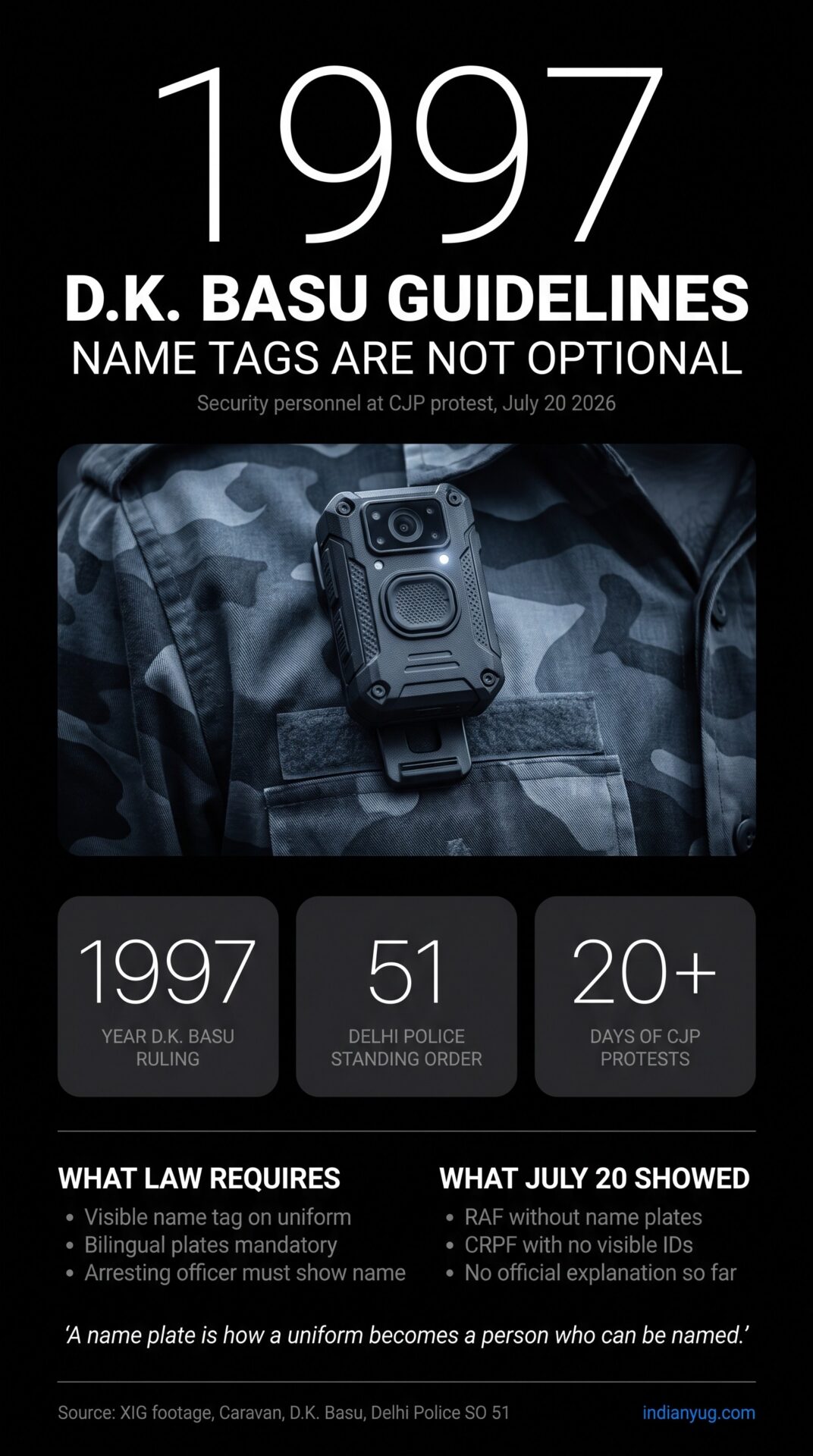
What the footage shows
Videos from the Cockroach Janta Party protest site moved across X and Instagram. Multiple clips show ranks of personnel without clearly visible name plates or badge numbers.
A journalist’s camera lingered on CRPF lines with no plates in view. Other videos focus on RAF units in the same condition. Caravan Magazine’s Instagram feed put the claim in plain language: most of the Rapid Action Force personnel at the site had removed their name badges to stop identification.
CJP supporters said what accountability lawyers in this country have said for years. If you can’t name the officer, you can’t name the abuse.
None of this is, by itself, a court finding. Social media isn’t a commission of inquiry. But the volume of independent footage is hard to dismiss as a single deepfake or a single angry account. The images are repetitive. The absence is consistent. And by the time this article closed, neither Delhi Police nor the Union Home Ministry had issued a specific public explanation for why name plates weren’t visible on so many chests that day.
That silence is part of the story.
Why a plastic rectangle matters
A name plate looks like the smallest piece of kit. Black background, white letters. Or white background, black letters. Bilingual. Rank. Surname. It costs less than a baton. It weighs almost nothing.
It’s the thin line between state power and anonymous force.
When a protester is shoved, when a lathi lands, when someone is dragged into a van, accountability begins with identity. Who gave the order. Who swung the stick. Who held the arm. FIRs, magisterial enquiries, NHRC complaints, RTI applications, and later court affidavits all need a name. Without it, the file opens on a ghost.
India’s higher courts understood this long before CJP existed. In D.K. Basu v. State of West Bengal (1997), the Supreme Court laid down arrest guidelines that still sit on every police training wall. The first of those guidelines is blunt. Police personnel carrying out an arrest and handling interrogation must bear accurate, visible and clear identification and name tags with their designations. The particulars of such personnel must be recorded.
Delhi Police’s own Standing Order on uniform makes the same point in the force’s own language. A plastic name plate, bilingual, is listed as part of working dress across ranks. The standing order also recalls the Supreme Court’s direction in D.K. Basu: an officer effecting arrest must wear a name plate showing name and rank.
So this isn’t an activist slogan invented on July 20. It is doctrine. It is internal order. It is supposed to be routine.
What July 20 made the rule collide with
July 20 wasn’t a quiet policing day.
Delhi Police had placed prohibitory orders under Section 163 of the Bharatiya Nagarik Suraksha Sanhita around the Parliament zone. Five Metro stations were shut. Multi-layer barricades went up between Jantar Mantar and the new Parliament complex. Estimates of the crowd ran from the police figure of about 10,000 to higher claims from organisers. Tear gas was used. Baton charges were reported by multiple outlets. CJP founder Abhijeet Dipke was detained. An FIR against protesters was announced. Talks with BJP president J.P. Nadda happened the same day and produced no public concession.
In that setting, name tags aren’t ceremonial. They are the difference between lawful crowd control and untraceable force.
If personnel were acting under lawful orders, the tags should have been on. If some of the people in kit weren’t who they appeared to be, the absence of tags is worse. Either way, the public is left staring at the same blank chest.
The standard defence, and why it fails here
There is a familiar counter-argument. Riot units under high tension sometimes hide identity to stop doxxing and revenge attacks on families. Other countries do versions of this. The fear isn’t imaginary. Officers have been targeted online after communal clashes and high-profile raids.
But the defence collapses under three problems.
First, Indian law didn’t create an open-ended exception for “tense days.” D.K. Basu was written precisely for moments when the state uses coercive power against citizens. The harder the day, the more the identification rule matters, not less.
Second, operational security for officers can’t erase the security of the people they police. A democracy doesn’t get to choose only one side of that balance. If families of personnel need protection, the answer is better internal safeguards, not a blank public face.
Third, July 20 already included the full catalogue of force that makes identification urgent: chemical agents, physical charges, detention of a movement founder, and the opening of criminal process. Anonymity in that package isn’t a technical detail. It is a political choice. It tells the crowd: we will use force, and you won’t know whom to name.
Not the first time, but still not normal
India has seen this argument before. After communal riots, after university crackdowns, after late-night “encounters,” lawyers and journalists have repeatedly asked why belt numbers vanished and why name plates were covered. Human rights groups have documented the pattern for years. Courts have scolded forces for it. Standing orders have been rewritten. And still, on the next hard day, the plates disappear again.
What makes July 20 different isn’t that the practice is brand new. What makes it different is the contrast.
The protesters had spent weeks making themselves hyper-visible. They wore the insult “cockroach” as a badge. They held Gandhi portraits. They carried copies of the Constitution. They filmed everything. Their founder has a name that every channel now knows. Their hunger strikers have names. Their dead demands are written on placards in block letters.
The state’s answer, in large parts of the line, was to become less visible.
One side insisted on being seen. The other side, at the point of contact, often refused to be named.
That asymmetry is the civic wound.
What “unprecedented” should mean carefully
Is a missing name plate unprecedented in Indian policing? No. The historical record won’t support that sentence.
Is a visual record of RAF and allied personnel without plates, on the day a Gen Z movement marched on Parliament, with tear gas in the air and an FIR announced, a serious break from what a republic owes its citizens? Yes.
“Unprecedented” should attach to the political meaning, not to a claim that no Indian policeman ever removed a tag before. The meaning is this: on the most watched student protest day of 2026, accountability hardware was optional at the front line.
The legal floor, not the ceiling
D.K. Basu is about arrest and interrogation. Crowd control is wider than arrest. Not every person in a cordon is effecting an arrest at every second. Defenders of the force will lean on that distinction.
They shouldn’t lean too hard.
When a cordon becomes a charge, when tear gas is fired, when people are detained and an FIR is promised, the operation has crossed into coercive process. The spirit of the guideline isn’t a loophole hunt. It is a principle: the state’s hand must be identifiable when it closes on a citizen.
Delhi Police Standing Order 51 doesn’t treat the name plate as optional fashion for quiet days. It treats it as part of uniform. Combined with the Supreme Court line on arrest, the floor is clear enough for any honest reader. Personnel who may detain, strike, or process citizens should be identifiable.
If the Home Ministry believes riot kit creates a special exemption, it should say so in writing, in public, with the legal basis. It has not.
What accountability looks like after the smoke clears
A republic that takes this seriously doesn’t need poetry. It needs a short list.
One. Delhi Police and the central forces under MHA should state, on record, whether name plates were ordered removed, quietly discouraged, or simply not enforced on July 20.
Two. If plates were removed for “security,” the order should be produced. Who signed it. Under what power. For which units. For how long.
Three. Body-worn cameras and unit logs should be preserved for the hours of the march, the tear gas use, and the detention of Dipke and others.
Four. Any complainant who can identify a unit, a vehicle number, or a time stamp should still be able to file without being told that no officer can be named because no officer showed a name.
Five. The NHRC and the Delhi High Court, if petitioned, should treat missing identification during a mass public order operation as a rights issue, not a wardrobe mishap.
Call it what you will. Just remember what police power is for.
The deeper pattern around CJP
The missing tags fit a wider style of response to the Cockroach Janta Party.
First came ridicule. Education Minister Dharmendra Pradhan called the movement a “B-team of terror groups.” Then came medicalisation of politics: Sonam Wangchuk’s forced removal from hunger strike to hospital. Then came spatial denial: Metro shutdowns, prohibitory orders, multi-layer barricades. Then came kinetic force: tear gas, batons, detention. Then came legal wrapping: FIR talk.
And through the kinetic phase, in significant stretches of footage, came anonymity.
Each step reduces the movement’s ability to answer back inside the system. Ridicule attacks legitimacy. Hospitalisation removes a moral centre. Barricades remove geography. Force removes bodies from the street. Missing names remove the last address for complaint.
Seen this way, the blank name plate isn’t a side detail from a chaotic afternoon. It is the final lock on a chain of unanswerability.
What the students understood instinctively
Young people at Jantar Mantar may not quote D.K. Basu from memory. They still understood the point.
They kept saying, in Hindi and English, versions of the same line. Who are these people. Why no name. How do we know they are even who they say they are.
That last fear isn’t paranoia in a country that has seen men in uniform-like dress appear in riot zones. Visible identification protects honest officers as much as it protects citizens. It separates the force from impersonators. It protects the badge by making the badge mean something.
When the state removes that signal, it weakens itself. A force that won’t show its name asks the public to trust a silhouette.
The rose and the blank chest
July 20 will be remembered for many images. Roses against steel. A short road that felt longer than Dandi because of what it represented. A hunger striker removed before dawn two days earlier. A Gen Z column that learned, in one afternoon, how quickly symbolism meets the hard edge of the Indian security state.
Add one more image to that archive.
A row of men in kit. Batons ready. Smoke in the air. And on the chest, where the republic usually writes a name, nothing.
The protesters carried an insult and turned it into a movement. The state carried force and, in too many frames, declined to carry a name.
In a constitutional democracy, that’sn’t a small irregularity. It is a warning about how power prefers to move when it doesn’t want to be followed home.
The name tag that wasn’t there isn’t a fashion failure. It is a governance choice. And choices like that, once filmed, don’t leave the public memory as quickly as the tear gas leaves the air.
Sources
Viral footage and posts from Jantar Mantar, July 20, 2026 (X, Instagram); Caravan Magazine Instagram note on RAF name badge removal; Al Jazeera, The Hindu, BBC, DW, ETV Bharat coverage of the CJP Parliament march and police action; Supreme Court guidelines in D.K. Basu v. State of West Bengal (1997) on visible name tags during arrest and interrogation; Delhi Police Standing Order No. 51 (uniform), including plastic name plate requirements and reference to D.K. Basu; Delhi Police / ANI statements on prohibitory orders and Metro restrictions, July 20, 2026. No specific official explanation for missing name plates located at time of writing.


