They Called for Help From Under the Concrete. The City That Praised Their Ambition Was Listening Somewhere Else

Six floors of a Sunday afternoon folded into dust, and the young men inside were still on their phones, asking to be found. This is not a tragedy. It is a verdict on every adult who looked away.
The dust took a moment to settle. That is the mercy of these things, and the only one. For a few seconds the lane was a grey wall, and then the grey began to cough, and the coughing became screaming, and the screaming resolved into the sound that would carry through the night. Boys, under the rubble, calling out.
It was a Sunday, so most of them were in their rooms. Some had managed to keep a signal through the collapse, and they used the last of their phone batteries the way you would, not to say goodbye, but to beg. Rescuers lowered oxygen canisters into the gaps and listened. The voices were young. They kept asking to be found. Then, one by one, they stopped.
Here is what happened, for anyone who has not followed the news and does not deserve to be kept in the dark any longer. On Sunday afternoon, September 6, in Satya Niketan, the cramped student quarter beside Delhi University’s South Campus, a building near the Shiv Mandir gave way around 1.30 pm. It was five storeys tall and fifty years old, and it was a paying guest hostel for young men, run under the name Hostel Daze, in a lane where every other house has been quietly turned into rooms for rent. Dozens of students were inside. Some were from Kerala, some from Haryana, some from Uttar Pradesh. Many studied at Motilal Nehru and Sri Venkateswara, colleges across the road. Their families will read the lists of the rescued and the recovered for days, and some of them will not find the name they are looking for.
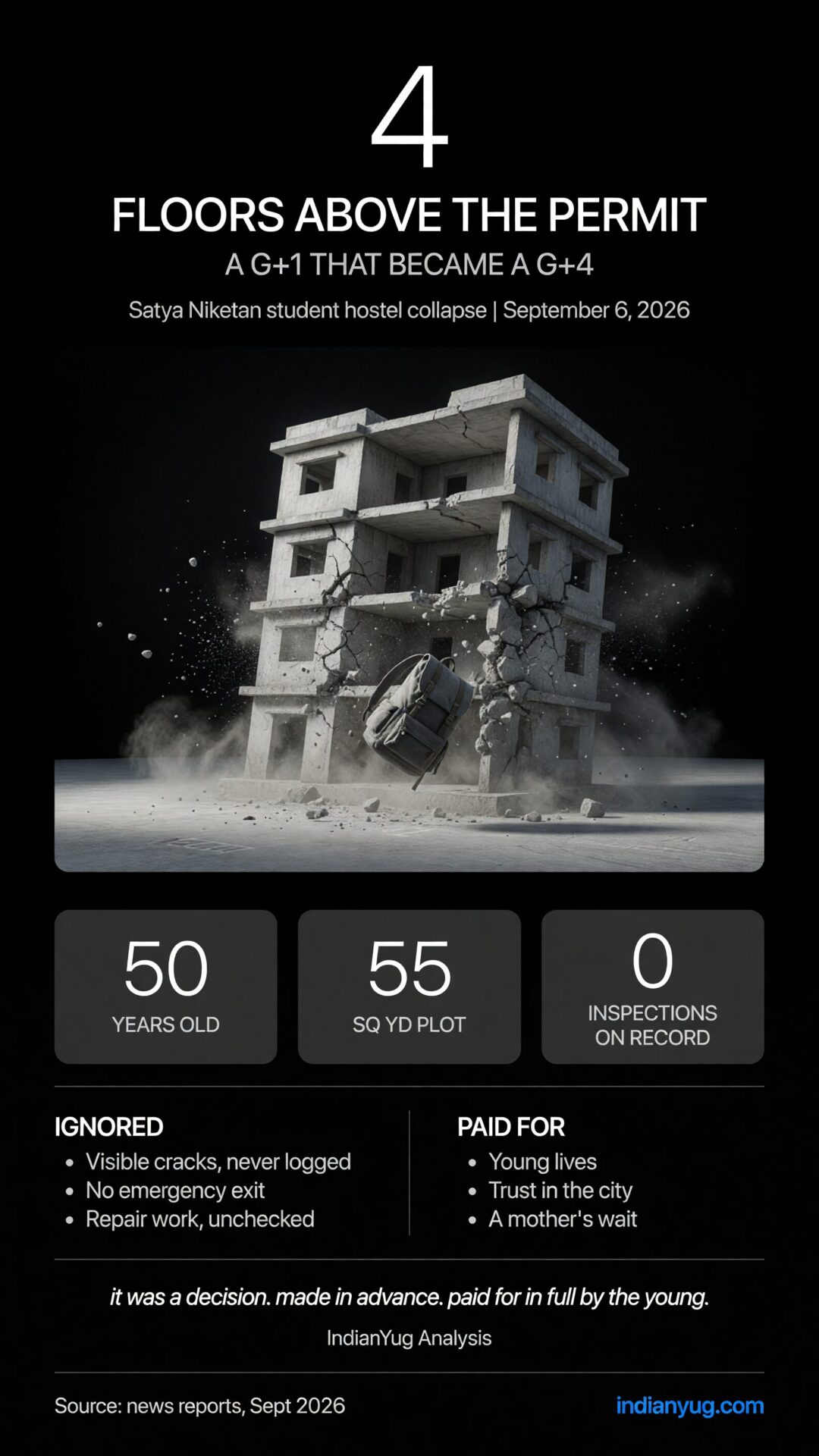
The building was permitted, when it was built, as a ground-plus-one. It died as a ground-plus-four. That sentence is the whole story. Everything else is detail.
What the rubble has already told us
The demolition crews are still clearing the dust, and already the rubble has testified more honestly than any official has. It says the building stood on a 55-square-yard plot in a resettlement colony, a plot that was never meant to carry what was stacked on it. It says the paper permission stopped at one floor and the construction did not. A G+1 that becomes a G+4 is not a renovation. It is a negotiation with gravity, conducted in silence for decades, and gravity collected.
Repair work was underway in the basement and ground floor when the building fell. Days of rain had left water standing in the basement, and locals believe it softened whatever was left of the foundation. The civic body has said it had no record of any booking, no record of any sealing, no complaint about the work. No record. No complaint. Nothing to see. A commercial hostel, full of students, in the capital of the country, and the entire machinery of inspection produced that answer at every single touchpoint.
There had been visible cracks. People on that lane saw them. The cracks were the building speaking its condition long before it spoke its collapse, and everyone read them the way the powerful always read warnings from the powerless, which is quickly, and then not at all.
The city has confirmed, only after the fall, that the building carried four floors above its permit, that repair work went ahead with no proof of supervision, that the hostel had no proper emergency exit, that nobody had ever verified it was legally allowed to take money for beds. The same city that can seal illegal floors within hours of a tragedy could not find those illegal floors in all the years they stood. That is not a failure of information. That is a failure of will, and the rubble is its monument.
The city that has no room for its students
Now the question that nobody in uniform wants to answer. Why were those boys in that building at all?
Delhi University admits well over a lakh students every year across its colleges. Its hostels hold a few thousand. That gap is not an oversight. It is policy by neglect, renewed annually, and its consequences are as predictable as gravity. Every year the university admits young people from towns that do not have a college like this, takes their fees, and does not give them a room. The state that celebrates their ambition does not build the hostels that ambition requires. So the market stepped in, and the market built PGs. It built them on residential plots, without licences, without fire escapes, without inspection, without any adult asking whether the man collecting the rent understood what his building could bear.
A student from a small town does not choose between a safe room and an unsafe one. He chooses between an unsafe room he can afford and a commute that will eat the hours his family is paying for. The boy from Kerala who slept in a building four floors taller than its permit did not have a safety inspector on call. He had a semester fee, a rent deadline, and the address of the only place near his college that would take him. The building that killed him was not his choice. It was the only choice he was given.
And here is the part that should be unbearable, and is instead routine. The people who sleep at risk are never the ones whose signature is on the permission. The owner who collected rent for a death trap, the contractor who dug at its base, the inspector who walked past four storeys of illegal building and saw nothing, the official who received no complaint because no complaint was ever filed, the resident who saw the cracks and told himself they were just what old buildings do. Every one of them could have acted. The boy could only trust. That is the whole architecture of this tragedy, and it is the architecture of a thousand others.
The speech and the silence
Now come with me, for a moment, a few kilometres away and twenty-four hours earlier.
On the morning of September 5, Teachers’ Day, the Prime Minister of India stood before the students of Shri Ram College of Commerce, in Delhi University, at the college’s centenary celebrations. There were lights, there was a stage, there was the particular energy of a leader speaking to the young. He told them about their aspirations. He spoke about young India, about the future being built by the next generation, about everything that the youth of this country will become. It was reported as a historic visit. Cameras loved it. The students in that hall were the future of India, and they were told so, and it must have felt, in that moment, like the country believed in them.
Twenty-four hours later, a few kilometres down the same road, a building fell on students of the same university. The boys under the rubble in Satya Niketan were also the future of India. They were the ones who did not get a seat in that hall, or in a hostel, or in anything the state had built for them. They were the young India the speech was about, sleeping in the one building nobody had checked, in the lane the city never inspected, under the floors the law never allowed. The stage was in one part of Delhi University. The collapse was in another. The distance between them was not kilometres. It was a few thousand hostel beds.
No one is accusing the Prime Minister of causing this. That would be stupid, and it would also be a way of letting everyone else off the hook. But the juxtaposition is not stupid. It is the whole story in two frames. The state has time to celebrate young India’s aspirations. It does not have time to inspect the buildings where those aspirations sleep. It can fill a hall for a speech about the future of the youth, but it cannot find the manpower to walk down one lane and count the floors above the permits. Both things happened in the same university system, within one day of each other, and only one of them was photographed.
The condolences arrived quickly, from every office, within hours of the dust. Condolences are cheap. They always arrive. What had not arrived in fifty years was an inspector.
A political circus over the rubble
Then the parties arrived, and the rubble became a backdrop, and the young men still being pulled from it became a prop in someone else’s argument.
The Chief Minister visited the site, ordered a magisterial inquiry, promised strict punishment. The mayor promised action up to immediate dismissal for officials who allowed illegal structures, and ordered a sealing drive. The local MLA stood at the site and said nothing could be more heartbreaking, and he was right, and he was also a politician saying it. From the opposition, the Congress leader spoke of the inhumane conditions students are forced into by the hostel shortage. The former chief minister said the government should wake from its slumber. A student party demanded a safety audit of every PG in the city. ABVP students forced their way into the civic headquarters and fifteen were detained.
Every party found the tragedy useful. None has answered the question the rubble is asking. Which of these parties, in the years when it held the municipality or the state, inspected a single paying guest accommodation? Which one built the hostels that would have made Hostel Daze unnecessary? Which one filed the complaint about cracks that everyone now claims were visible? The blame is being traded like currency over bodies that are still being recovered, and the politicians are arguing about who should have saved these boys while the rescuers are still trying to.
The sharpest indictment is not that they are fighting. It is that the fight is the point. As long as the argument is about which party failed, it is not about the system that made the failure certain. And the system is what killed these boys. The parties are the management of the system. They are not its critics. They are its beneficiaries, every one of them, and the boys in the rubble had no party, no MLA, no voice in any of this. They had a rent receipt and a mother waiting for a call.
Who owns the beds
Ask the question that no press conference has touched, because it points at too many people in the room.
Who owns the paying guest accommodations of Delhi?
The PG business is one of the largest unregulated markets in the capital. It runs on cash, on word of mouth, on notices pinned to college boards. There is no registry of PG owners. No requirement that the people who profit from housing students disclose who they are. The building that collapsed had no record of being booked, no record of being sealed, no record of complaint. That is not a filing error. It is the operating condition of the entire business, and it has been for decades.
Students in these neighbourhoods have long alleged that some of the people profiting from PGs are the same people who are supposed to regulate them, political figures and their families, across parties. This allegation has never been investigated, and it cannot be, because there is no list to investigate. I am not repeating those names as fact. I am stating the fact that makes them untestable: Delhi does not know who owns the buildings that hold its young people, and no one in power has ever wanted a list. The local MLA was among the first at the site, and that is what elected representatives should do, and the students in the lane have their theories about why he was there so fast, and I will not repeat them, because the scandal is not the theories. The scandal is that the theories cannot be checked.
Until there is a public register of every building operating as a student hostel, its owner, its permitted height, its fire certificate, its last inspection, the phrase strictest action is just a press release. You cannot take strict action against a name you have never required anyone to write down.
Whose job was it
The only honest grief insists on the question. Whose job was it, and why did nobody do it?
It was the owner’s, not to stack floor on floor on a licence for one. It was the contractor’s, not to dig at the base of a decaying frame without an engineer swearing it was sound. It was the inspector’s, to walk past four storeys of building with a permit for one and see the difference. It was the civic body’s, to know that a residential lane had quietly become a commercial lodging colony and to treat that as information worth acting on. It was the university’s, to admit students it could not house and call it education. It was every politician’s, in every party, who made speeches about students while the students slept in buildings nobody checked. It was everyone who saw the cracks and decided that cracks are just what old buildings do.
An FIR names the owner, who is on the run, on charges including culpable homicide and endangering public safety. His flight is its own confession. A magisterial inquiry has been ordered. A sealing drive has begun. All of this is correct. All of this is also too late for the families now arranging to carry their children home.
The young men who died were not unknown to the state. They were its investment. They were the reason those colleges exist, the reason those lanes are paved, the reason the landlords of Satya Niketan have rented illegal floors for a generation. They were the raw material of the country’s future, housed in the one commodity the country refused to inspect. The collapse of Hostel Daze is not a building falling. It is the career of the shrug completing itself, on top of the young.
The debris will be cleared. The lane will reopen. Somewhere a new PG will be advertised, and a new boy will arrive from another state with his books and his parents’ hopes, and he will ask the price of a bed and will not think to ask whether the building is taller than the paper that says what it may be. The inquiry can name the guilty. Only the city can choose not to bury more of its children to keep the price of a room low. But first, someone has to say plainly what happened in Satya Niketan. It was not nature. It was not fate. It was not an accident.
It was a decision. Made in advance. Paid for in full, on a Sunday afternoon, by the young, while the city that had praised their future the day before listened to the sound of it collapsing, and reached for its condolences.
The IndianYug inquiry will keep tracking this story. If you lived near the collapsed building in Satya Niketan, knew any of the students, or saw the cracks being reported to anyone who ignored them, write to us.
Sources: India Today, The Times of India, Hindustan Times, News18, The Hindu, NDTV, The Indian Express, PTI and Reuters reporting as of September 7, 2026. Casualty figures have been deliberately omitted because they were still changing at the time of writing. All structural and procedural claims were confirmed by at least one named outlet. The passage on who owns Delhi’s PGs is framed as an allegation under public discussion because no registry exists to verify it. The juxtaposition of the Prime Minister’s September 5 address at SRCC with the September 6 collapse is the author’s editorial framing, based on the confirmed dates of both events.


