India’s Angry Students May Become the BJP’s Biggest Problem in 11 Years

The Students Are Angry. That Should Worry The BJP More Than The Opposition Does
A Government That Survived Everything Is Facing A Different Kind Of Crisis
Over the last 11 years, the BJP has survived wave after wave of public anger.
Farmers protested for months. Inflation became a constant complaint. Opposition alliances formed and collapsed. Critics accused the government of centralising power too aggressively. Yet election after election, Narendra Modi’s political machine kept moving forward.
But the mood building among students and young job seekers feels different.
Because this anger is not ideological.
It is personal.
- A leaked paper is personal.
- A cancelled exam is personal.
- An answer-sheet mix-up is personal.
- Years lost in preparation are personal.
And for the first time in years, the BJP is facing a form of frustration that cuts directly into the dreams of middle-class India.
The timing has made the situation even more volatile. Student anger is rising at a moment when ordinary households are already under financial pressure from increasing fuel prices, inflation concerns, and the wider economic impact of the Iran conflict.
India, which imports a major portion of its crude oil, has already seen multiple petrol and diesel price hikes linked to disruptions in global oil supply and tensions around the Strait of Hormuz.
For many middle-class families already spending heavily on coaching, education, transport, and daily expenses, the combination of exam uncertainty and rising living costs is creating a deeper sense of frustration that goes beyond politics.
The NEET Crisis Has Become A National Symbol Of Broken Trust
The NEET controversy is no longer just an examination scandal.
It has become a symbol of institutional collapse in the eyes of many students.
More than 24 lakh students registered for NEET-UG, one of the world’s largest entrance examinations. Then came allegations of paper leaks, suspicious score patterns, arrests, investigations, and eventually CBI involvement.
What turned frustration into rage was repetition.
Students expected reforms after the 2024 controversy. Instead, NEET-UG 2026 once again found itself surrounded by allegations of leaks, cancellation chaos, protests, and fresh investigations.
For lakhs of students, this stopped being about one exam.
It became proof that the system itself could no longer be trusted.
Then Came The Suicides
The darkest part of this crisis is that it is no longer limited to online outrage.
Multiple reports over the past two weeks linked student suicides to stress surrounding NEET cancellation and exam uncertainty.
A student in Maharashtra allegedly died by suicide after the NEET-UG 2026 cancellation, with family members linking the emotional breakdown to the controversy.
A NEET aspirant in Rajasthan’s Sikar was reported to have been deeply disturbed after the cancellation.
Another case from Uttar Pradesh involved a student whose family directly blamed the exam cancellation and paper leak controversy.
Police investigations are still ongoing in several cases, and it would be irresponsible to reduce complex tragedies to a single reason.
But the pattern itself is disturbing.
India’s competitive exam culture was already emotionally brutal. Now, uncertainty around fairness is making it even worse.
The CBSE Answer-Sheet Incident Made Things Worse
Then came another controversy that exploded online for a completely different reason.
A Delhi student claimed that the Physics answer sheet uploaded under his roll number was not his. He pointed to different handwriting and mismatched answers. Instead of getting immediate help, he was mocked online and even called “Pakistani” by some social media users after the issue went viral.
What made the incident politically damaging was what happened next.
CBSE later admitted that the wrong answer sheet had indeed been uploaded and sent the student the correct copy. Initially, however, the student faced intense online abuse after raising the issue publicly. Some social media users branded him “Pakistani” and accused him of trying to defame CBSE before the board itself acknowledged the mistake.
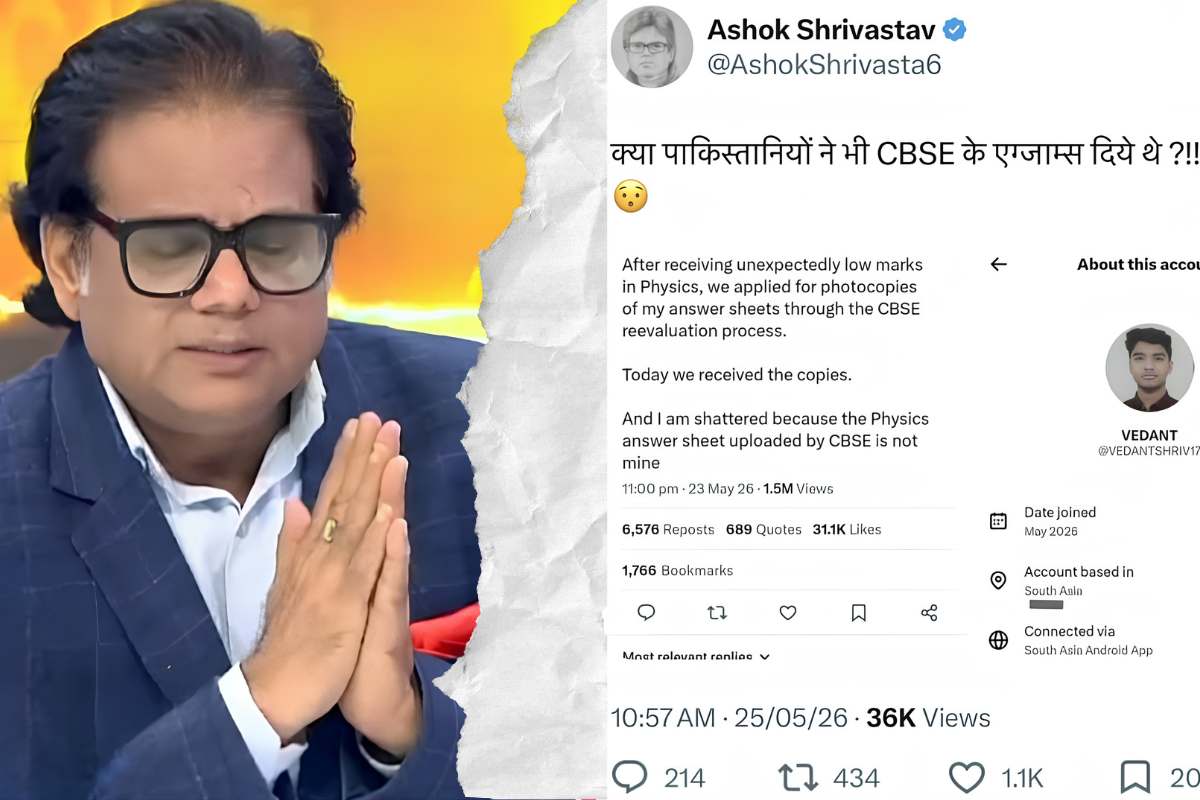
The controversy escalated further when Ashok Srivastava mocked the student online and suggested the complaint was part of an attempt to malign Indian institutions.
Critics later pointed out that the student’s claims were validated once CBSE admitted the answer-sheet mix-up. The episode quickly became a larger debate about how students raising legitimate grievances are sometimes attacked before facts are verified.
Rahul Shivshankar also commented on the controversy, questioning why the student had gone public on social media instead of following institutional mechanisms first.
After CBSE confirmed the mismatch, critics argued that sections of the media had rushed to discredit the student rather than investigate the complaint seriously.
Suddenly, what many had dismissed as “attention-seeking” turned out to be real.
The controversy became bigger than one student’s marks.
It reinforced a growing fear among students that even basic institutional processes cannot be trusted anymore.
And this happened just as anger around NEET was already boiling.
Rahul Gandhi Has Sensed An Opening
For years, Rahul Gandhi struggled to connect with young voters in a politically meaningful way.
That appears to be changing.
Over the past few weeks, he has aggressively positioned himself as a voice for students and exam aspirants. He publicly backed the CBSE student whose answer sheet issue went viral and attacked the government over what he described as the fear of questioning youth voices.
He has repeatedly targeted the government over paper leaks, unemployment, and exam failures, trying to frame them not as isolated mistakes but as evidence of deeper governance failure.
This matters politically because student frustration is emotionally relatable across class and caste lines.
Almost every Indian family today knows someone preparing for NEET, UPSC, SSC, CUET, banking exams, railways, or state recruitment tests.
The issue travels naturally into households.
And unlike older political narratives, this one spreads instantly online.
The Rise Of The “Cockroach Janta Party” Shows Something Bigger Is Happening
At first glance, the “Cockroach Janta Party” looked like another internet joke.
It was not.
The satirical online movement exploded across social media after controversial remarks comparing unemployed youth to cockroaches triggered backlash. What began as dark humour quickly turned into a wider expression of Gen Z frustration around unemployment, rising costs, exam scandals, and political arrogance.
Reuters reported that the movement rapidly gained millions of followers online and attracted huge engagement from young Indians.
The BJP dismissed it publicly. Haryana Chief Minister Nayab Singh Saini called it politically amplified noise.
But dismissing it entirely may be a mistake.
Because the movement itself is less important than what it represents.
For the first time in years, youth frustration is finding a common online language.
Not through traditional protests.
Not through student unions.
Not through ideology.
Through memes, satire, reels, and digital anger.
That is much harder to control.
A Decade Of Cancelled Exams Has Created A Trust Deficit
The NEET crisis did not emerge in isolation.
Over the last decade, India has repeatedly witnessed controversies involving:
- NEET paper leak allegations
- SSC recruitment controversies
- Railway recruitment protests
- State-level teacher recruitment scams
- Police recruitment paper leaks
- CUET technical failures
- UPPSC examination protests
- Bihar constable recruitment cancellations
- REET paper leak controversy in Rajasthan
- Multiple state PSC exam cancellations
Each controversy added another layer of distrust.
Students now prepare with the assumption that delays, leaks, cancellations, court cases, or irregularities are almost inevitable.
That psychological shift is dangerous for any government.
Because once young people stop trusting institutions, rebuilding confidence becomes extremely difficult.
The Real Problem Is Not Just Corruption. It Is Scarcity
At the centre of this anger lies one brutal reality.
Too many people are fighting for too few stable opportunities.
That is why every exam controversy feels explosive.
For millions of families, government jobs and elite educational institutions are not prestige goals anymore. They are survival strategies.
Parents spend savings on coaching.
Students lose years preparing.
Entire households revolve around one examination cycle.
When papers leak or exams collapse, people do not see administrative failure.
They see stolen futures.
And that is why this issue could become far more politically dangerous than many in Delhi currently realise.
This May Become The BJP’s Most Difficult Challenge Since 2014
The BJP remains electorally powerful.
Modi’s personal popularity remains significant. Welfare schemes continue to matter enormously. The opposition is still fragmented in many states. Recent assembly election wins prove the BJP is far from weak.
But politics is not only about who wins the next election.
It is also about public mood.
And among many students and young job seekers, something is clearly changing.
The anger is becoming cumulative.
- One leaked paper can be forgotten.
- One cancelled exam can be managed.
- One technical glitch can be defended.
But when controversies pile up year after year, trust slowly erodes.
A government that built its image around discipline, control, and efficiency now faces a generation increasingly convinced that the system is chaotic precisely where fairness matters most.
And once that belief spreads deeply enough, it becomes much harder to fix than an exam paper.


