India’s AI Talent Drain: Why 100+ Founders Are Leaving and What It Costs the Country

It’s a Tuesday afternoon at a Bengaluru AI startup. The CTO just resigned — an offer from OpenAI’s San Francisco office. Three senior ML engineers are likely to follow. The founder stares at a hiring dashboard showing 42 open positions and zero qualified applicants for the last two weeks. This scene is playing out in every tech hub in India right now.
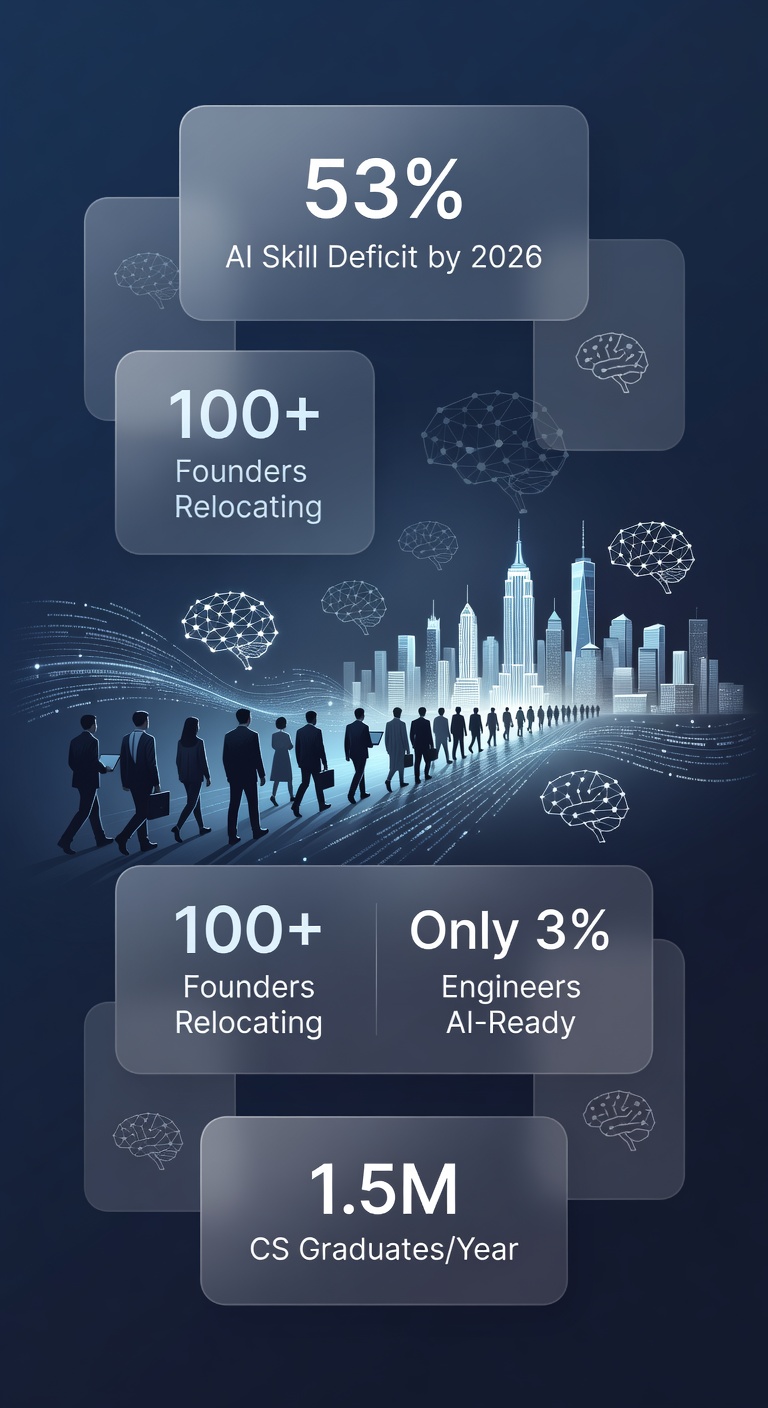
India produces 1.5 million computer science graduates every year — more than any other country. Yet somewhere between the graduation ceremony and the AI revolution, the numbers slip through its fingers like sand.
The Numbers That Tell the Story
India accounts for 12 to 15 percent of the global AI workforce. The Stanford AI Index 2025 ranks India among the top five in AI skills penetration and competitiveness. On paper, the country looks like an AI superpower waiting to happen.
But paper is where the story gets complicated.
Despite producing 1.5 million CS graduates annually, only about 3 percent of Indian engineers possess advanced AI, ML, or data science skills. That is roughly 45,000 graduates per year who are truly job-ready — against a demand growing at 25 to 30 percent annually, according to NASSCOM.
The math is brutal. By the end of 2026, India is projected to face a 53 percent AI skill deficit. The country needs to fill approximately one million AI roles in the next 12 months. With the current supply pipeline, that gap is more like a chasm.
Why They Leave: It’s Not Just About Money
A senior AI engineer in Bengaluru earns roughly ₹25 to 40 lakhs per year. The same engineer in San Francisco or Seattle commands $150,000 to $250,000. That is a 3x to 5x jump, often with equity in companies valued at hundreds of billions.
But money is only part of the story. More than 100 Indian AI startup founders have already relocated or are actively planning to move to the United States. Founders do not leave for a salary. They leave for an ecosystem.
Silicon Valley offers something India still struggles to provide: patient capital for long AI R&D, the world’s densest AI talent pool, research labs with million-dollar compute budgets, and a faster-moving regulatory environment.
The research funding disparity is staggering. The IndiaAI Mission approved Rs 10,372 crore — approximately $1.2 billion — over several years. OpenAI alone has raised over $20 billion and spends roughly $5-7 billion annually on compute and talent.
The big four US tech firms collectively spend over $100 billion per year on AI. No Indian company or even the combined government effort can compete at that level.
The Cost of the Drain on Indian Startups
The talent exodus is not a future problem. It is happening right now, and the damage is measurable.
Global Capability Centers — the R&D arms that multinationals set up in India — are reporting acute AI talent shortages.
This is the same GCC ecosystem that employs over 1.6 million people and generates $60 billion in annual revenue. They cannot find enough people to staff AI teams.
Indian AI startups raised approximately $14.5 billion in cumulative funding between 2018 and 2025. But capital is not the same as talent.
Founders report hiring cycles stretching six to nine months for senior AI roles. Some are quietly setting up engineering outposts in Eastern Europe and Southeast Asia because they cannot find qualified AI talent at home.
What Can Turn the Tide?
The IndiaAI Mission, with its Rs 10,372 crore budget, is a serious attempt. It aims to build a national AI compute infrastructure with over 10,000 GPUs, fund research centers at 50+ institutions, and create AI-skilling programs at scale.
The right building blocks. But the timeline is years, and the salaries in Palo Alto are not waiting.
Some Indian companies are fighting back. A handful of large tech firms and GCCs have started offering US-competitive compensation — packages crossing ₹1 crore per year with equity.
Wipro, Infosys, TCS, and the Indian arms of Google, Microsoft, and Amazon have launched internal AI upskilling programs. But upskilling a Java developer takes months, and building a world-class ML researcher takes years.
What India needs is not one solution but three running in parallel: drastically scaled up compute infrastructure so founders do not wait six months for GPU access, corporate R&D labs with real research budgets, and compensation that makes staying in India financially rational rather than an act of patriotism.
Key Takeaways
- India produces 1.5 million CS graduates a year but only ~3% have advanced AI skills — creating a 53% talent deficit projected by late 2026
- Over 100 Indian AI startup founders have relocated to the US, driven by 3-5x compensation gaps and dramatically better research infrastructure
- GCCs in India face acute AI talent shortages even as they employ 1.6 million people, forcing some startups to hire abroad or shut down
- The IndiaAI Mission’s Rs 10,372 crore is a strong foundation but pales against the $100B+ annual AI spend of US tech giants
- India’s only real competitive edge is volume — 1.5 million fresh graduates per year — but converting that into AI readiness requires a systemic overhaul of compute access, research funding, and corporate R&D culture


