Gen Z and the 2029 Verdict: The Generation That May Reshape Indian Democracy

The chai was ₹10, the Wi-Fi was free, and the argument was loud.
At a roadside stall near Jadavpur University in Kolkata, two days before the 2026 West Bengal assembly election results, a 22-year-old design student named Riya was explaining to her friend why she voted for the BJP. Not because she cared about Hindutva. Not because she hated Mamata Banerjee. Because, she said, her cousin had been trying to get a teaching job for three years and the TMC local office kept asking for a “donation.” The friend, Sameer, 23, had voted for the same party — but for the opposite reason. He wanted someone who wouldn’t bulldoze his neighbourhood mosque for a highway project.
Same team. Different gods.
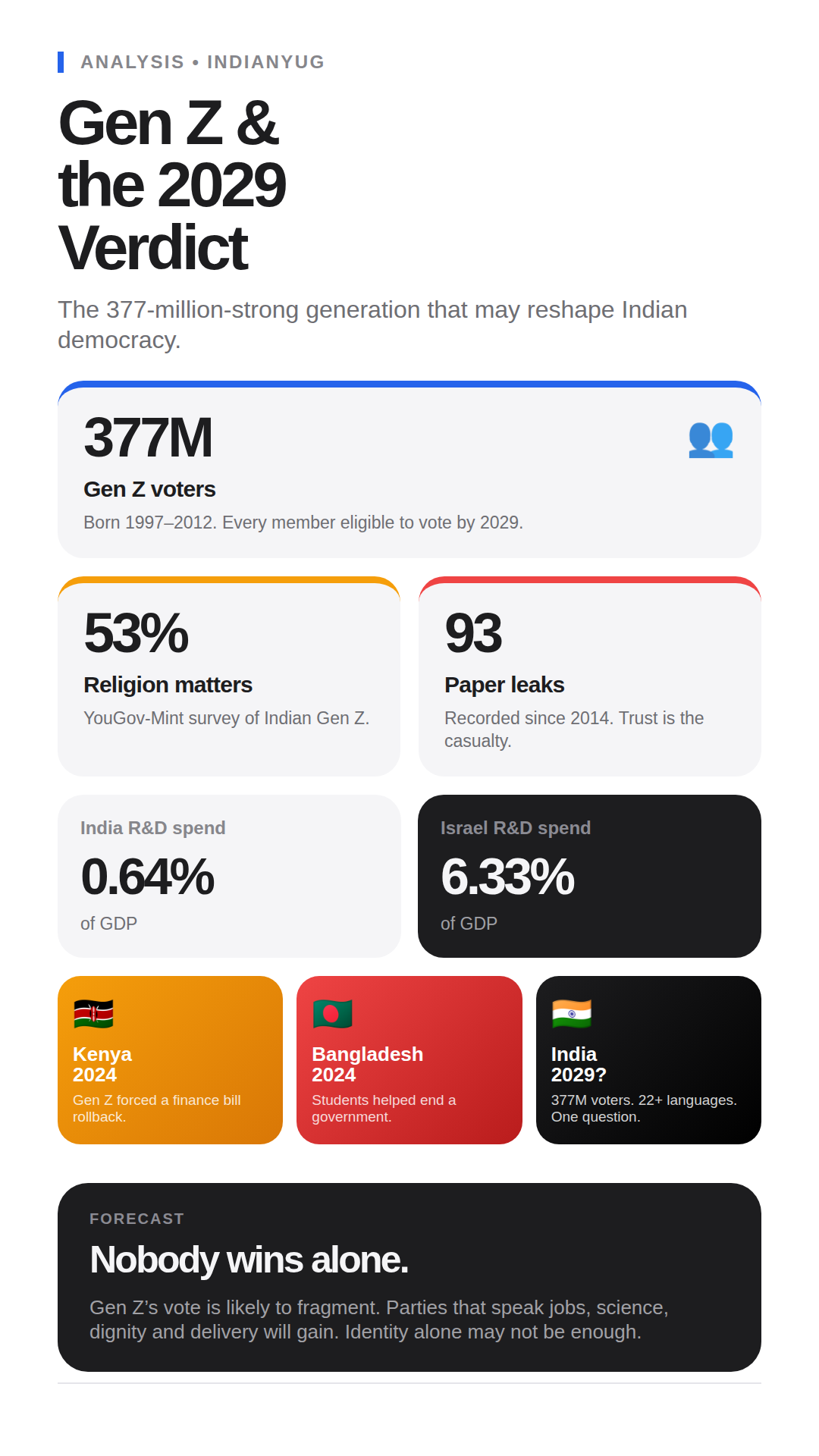
This is not a paradox. This is Gen Z India — 377 million people born between 1997 and 2012, all eligible to vote by 2029 — trying to make sense of a political system that was not built for them.
The Personal Price
Ask Anamika. She is 22, a NEET aspirant from Bihar, on her sixth attempt. “My whole life became just college and library,” she told the BBC in May 2026. “I gave up family functions, friends — everything. I thought this time it was finally certain.” Her exam was cancelled. The paper had leaked.
In Delhi, Manas Sharma, another NEET aspirant, described a similar routine to the BBC. “Since October, I have been studying 12 hours a day — not watching films or even hanging out with friends. That’s what it takes to get into a good medical college.” His effort, too, was invalidated by the leak.
These are not statistics. These are young lives stripped down to a single high-stakes exam, sustained by parental sacrifice, and then discarded by a system that cannot keep its own question papers secure. The personal cost of India’s broken examination machinery is not abstract. It is measured in years lost, families depleted, and trust destroyed.
The Systemic Failure
The numbers behind those stories are worse than the stories themselves.
Since 2014, India has recorded 93 exam paper leaks. The NEET-UG 2026 cancellation alone affected 2.28 million candidates. Sixty-seven percent of unemployed youth are graduates — up from 46 percent in 2017 — according to the State of Working India 2026 report published by Azim Premji University. Graduate unemployment among those aged 15 to 25 stands at 40 percent.
The education system that is supposed to prepare this generation is hollowing out from the inside. In April 2023, the National Council of Educational Research and Training (NCERT) removed Charles Darwin’s theory of evolution, the Periodic Table, and energy sources from Class 10 textbooks. The change affected an estimated 134 million students. Over 4,500 scientists signed an open letter protesting the removal of evolution from the curriculum.
The erosion goes beyond textbooks. In 2014, Prime Minister Narendra Modi claimed that the elephant head of the Hindu deity Ganesha was evidence of ancient Indian plastic surgery. He also cited the mythological figure Karna from the Mahabharata to argue that genetic science existed in ancient India. In 2017, BJP MP Satya Pal Singh — a former minister of state for education — called Darwin’s theory “scientifically wrong,” adding that “no one has ever said that they saw someone go into a forest and seeing a monkey that turned into a man.”
Amitabh Pandey, a scientist, captured the stakes plainly. “We are trying to compete with China. We are trying to compete with the U.S. But how is it possible without scientific temper, without scientific worldview? I’m afraid this is taking India backward.”
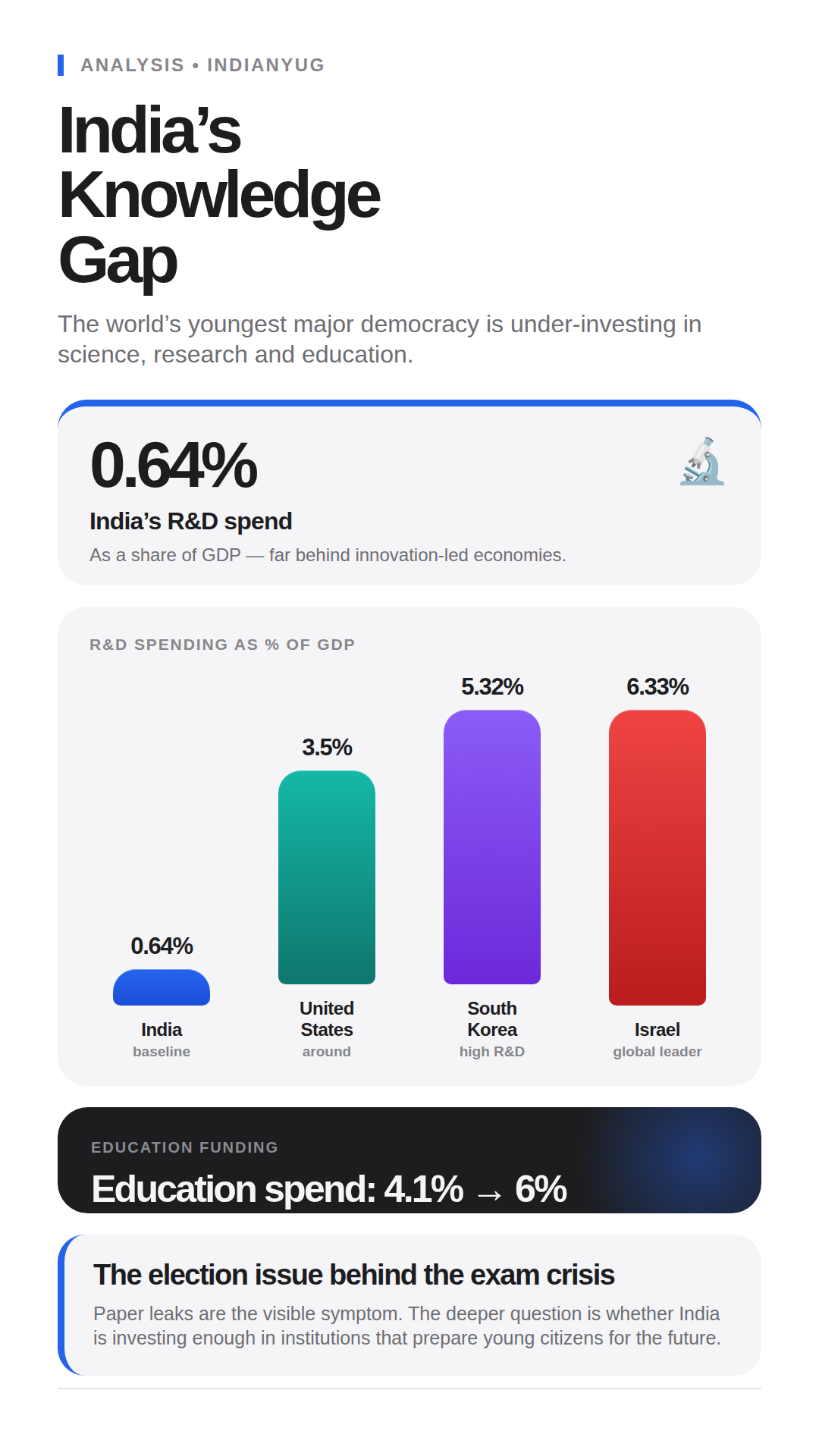
India spends 0.64 percent of its GDP on research and development. Israel spends 6.33 percent. South Korea spends 5.32 percent. The United States spends around 3.5 percent. Education spending sits at approximately 4.1 percent of GDP — still far below the 6 percent target set by the National Education Policy 2020.
The Indian Knowledge Systems (IKS) initiative, meanwhile, has channelled institutional energy into validating pre-modern Indian texts as science — a project that critics say replaces inquiry with nationalism.
The Political Landscape, Party by Party
No single party has a monopoly on Gen Z’s attention. The generation’s instinct, as analyst Rasheed Kidwai wrote in Down To Earth, is not ideological. “Gen Z is not necessarily left or right. It is not automatically secular or communal, radical, or conservative,” he noted. “It is anti-capture.”
Consider the options.
The Congress party, under Rahul Gandhi, has attempted a direct pitch. “I think all you guys need to join politics and change things,” Gandhi told a group of young girls in a widely shared interaction. “Generations above you have been slow, and we need you guys to get into the act.” When the girls called him “uncle,” he responded: “Call me bro then.” Praveen Chakravarthy, the Congress data chief, argued that “Gen Z voters are reshaping Indian politics, influencing older generations and pushing parties to evolve.” The Congress sees this generation as a demographic opening. Whether the party’s organisational machinery can match its rhetoric is a different question.
The BJP and Prime Minister Modi have dominated Indian politics since 2014, but their relationship with Gen Z is complicated. The government’s own education policies have alienated science-minded students. The exam paper leak crisis — 93 leaks in 12 years — has happened entirely on the BJP’s watch. Yet the party’s communication infrastructure, its digital ecosystem, and Modi’s personal brand retain significant reach among young voters, particularly in Hindi-speaking states.
Arvind Kejriwal’s AAP has made a direct bid for the student vote. “Since the Narendra Modi government assumed power in 2014, 93 paper leaks have been reported in the country,” Kejriwal said in a public address. “The future of at least six crore students has been ruined. So, I want to ask Gen Z, will it continue like this, or will you do something?” He drew an explicit international comparison: “If Gen Z can oust governments in Bangladesh and Nepal, can’t they send our corrupt leaders to jail?”
In Tamil Nadu, actor-turned-politician Vijay’s Tamilaga Vetri Kazhagam (TVK) won 108 seats on its electoral debut in the 2026 state assembly elections. According to Praveen Chakravarthy’s data, nearly 80 percent of people below 40 said they wanted to give the new party a chance and “were tired of the same old two-party establishment politics.” TVK’s rise is a textbook case of anti-incumbency filtered through celebrity and generational fatigue.
Then there is the Cockroach Janta Party. The name is not accidental. It comes from a remark by Chief Justice of India Surya Kant, who said in court: “There are youngsters like cockroaches, they don’t get any employment, they don’t have any place in profession.” The remark went viral. A satirical political movement formed around it. The CJP’s founder, Abhijeet Dipke, told media: “The Indian government has declared me a national security threat. They are trying to defame me.” The party now has 23 million Instagram followers — almost double the BJP’s.
A student named Sristhi told CNN in May 2026: “I believe the (Cockroach Janta Party) started as satire, but I really like the direction it’s going in. The youth need a platform where we can put up our demands, because most of the political parties somehow… miss the issues which are actually important.” Another young supporter, Amrita Singh, 21, from Delhi, was more direct: “They are raising the issues of the nation.”
Yogendra Yadav, the political activist, read the moment clearly. “If all was well with the country and the economy, 20 million young people would not rally around something like this,” he said. “This is a critical moment that tells us something about the state of our polity.”
What the Data Says
The demographic dividend that economists have talked about for two decades is not a permanent window. According to the Carnegie Endowment for International Peace, India’s demographic dividend begins closing from 2030. The country has less than five years to convert its youth bulge into productive employment before the population begins to age.
Fifty-three percent of Indian Gen Z believe religion is important, according to a YouGov-Mint survey — a number that complicates any simple secular-versus-communal framing. Arghyadeep Tarafder, writing in The Academic, argued that Gen Z’s politics are outcome-driven rather than ideology-driven. “Rather than adhering to left vs right ideologies, they prioritize concrete outcomes like job creation, mental health awareness, and digital rights,” he wrote.
Kidwai put it more sharply: “Young India is no longer behaving like a patient inheritor of old political scripts. It is impatient, comparative, anti-monopoly, deeply online, and increasingly willing to reward whichever force appears to offer a combination of disruption, dignity, and delivery.”
The Global Mirror
India’s Gen Z is not the first to be angry. In Kenya in 2024, young protesters forced President William Ruto to withdraw a finance bill. In Nepal, Gen Z-led demonstrations toppled a government. In Bangladesh, student protests against job quotas led to the fall of Sheikh Hasina’s government.
But India is different. Its scale is different. Its electoral machinery is different. Its media ecosystem — fragmented across languages, platforms, and propaganda networks — absorbs rage and disperses it in ways that smaller countries cannot replicate. Kejriwal’s invocation of Bangladesh and Nepal was deliberate. The question is whether India’s institutional density makes it harder for youth anger to crystallise into regime change, or simply means that when it does, the consequences are larger.
The Open Question
Riya and Sameer voted for the same party in Kolkata for entirely different reasons. Anamika and Manas studied 12 hours a day for an exam that was stolen from them. Twenty-three million people follow a party named after an insect that a chief justice compared them to.
The 2029 election will be the first in which every member of India’s 377-million-strong Gen Z cohort is eligible to vote. They are not loyal to a party. They are not bound by an ideology. They are, as Kidwai wrote, anti-capture.
The question that will define Indian democracy for the next decade is not which party wins their vote. It is whether the machinery of capture — the paper leaks, the textbook deletions, the unscientific claims, the 0.64 percent R&D spending, the jobs that do not exist — can adapt faster than a generation that has already decided it will not inherit the old scripts quietly.


