Delimitation Bill 2026 Explained: Why It Failed, The Revival Push, and What It Means for North vs South

On April 17, 2026, the Lok Sabha voted on a constitutional amendment that would have redrawn India's political map for the first time in half a century.
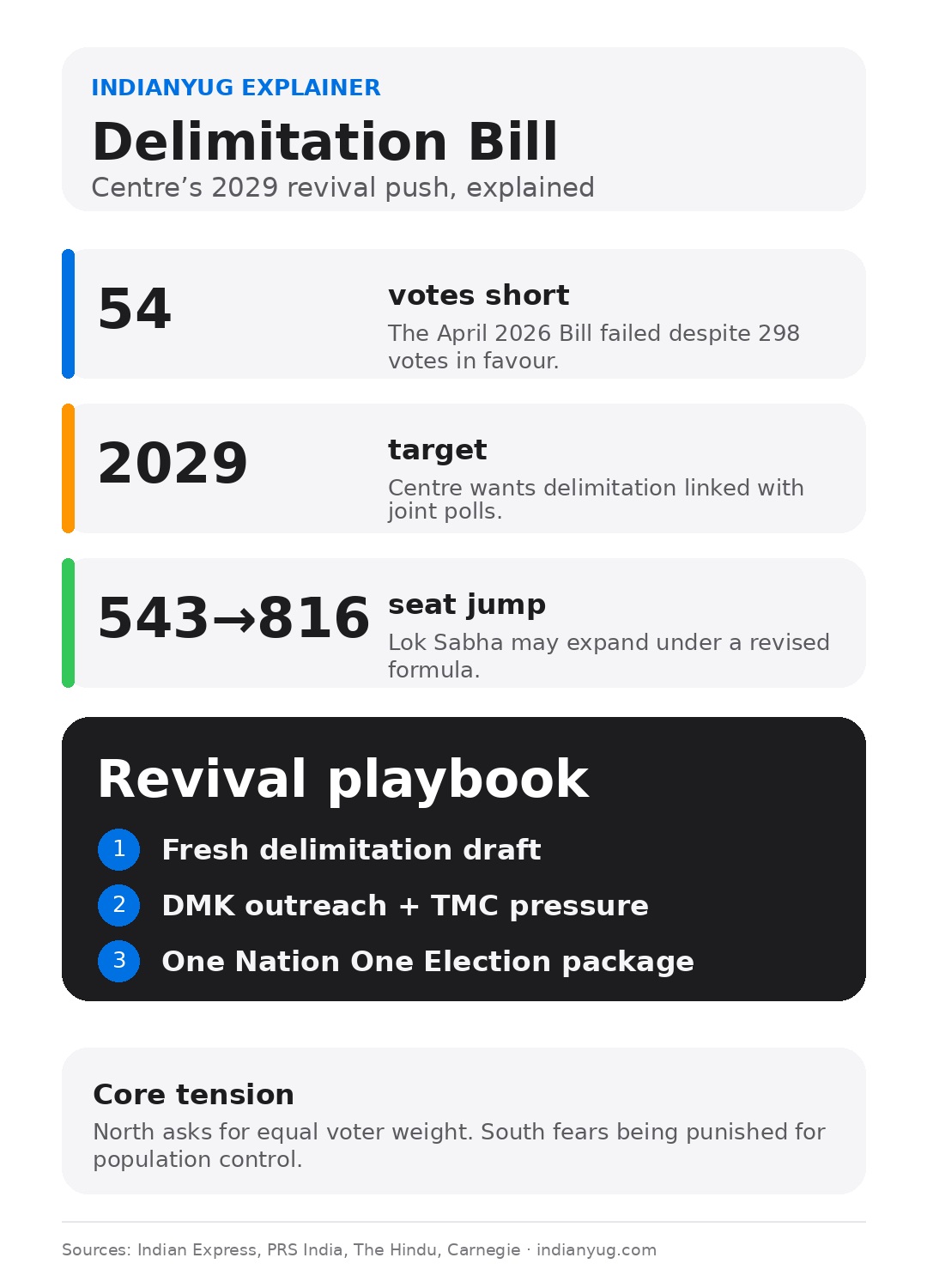
The Constitution (131st Amendment) Bill needed 352 votes — a two-thirds majority of the 528 members present. It got 298. That was 54 short.
After the defeat, the government withdrew two accompanying Bills: the Delimitation Bill, 2026 and the Union Territories Laws (Amendment) Bill, 2026. The entire package collapsed.
But the issue did not. In fact, barely six weeks later — emboldened by the BJP's victory in the April-May 2026 assembly elections, including a historic win in West Bengal — the Centre is preparing to revive both the delimitation Bill and the One Nation One Election (ONOE) Bill with a new strategy: outreach to key regional players and a fresh draft aimed at the 2029 Lok Sabha elections.
The Indian Express reported on June 1, 2026 that the Union Home Ministry is drafting a revised version of the delimitation legislation. Simultaneously, the 39-member Joint Parliamentary Committee reviewing the ONOE Bill, chaired by PP Chaudhary, has had its tenure extended until the Monsoon session. Chaudhary told the media: "The law will be amended soon. We are making good progress as far as the report is concerned, and we will submit the report in time."
The government's roadmap: pass the ONOE Bill and the delimitation package in time to synchronise the 2029 Lok Sabha elections with state assembly polls.
The revival cannot happen through numbers alone — the last attempt fell 54 votes short. So the BJP is trying a different playbook: peeling off regional parties one by one.
What Is Delimitation and Why Does It Matter?
Delimitation is the process of redrawing electoral boundaries so that each MP represents roughly the same number of people. India's Constitution originally required this after every census — Article 82 mandated reapportionment of Lok Sabha seats, and Article 170 did the same for state assemblies.
After the 1951, 1961, and 1971 censuses, delimitation was conducted as designed.
Then it stopped.
In 1976, Indira Gandhi's government passed the 42nd Amendment during the Emergency, freezing seat allocation based on the 1971 census until after the 2001 census. The stated reason: states that successfully controlled population growth should not be punished by losing political seats.
In 2002, the 84th Amendment extended the freeze until the first census after 2026.
That is how India's Parliament arrived at June 2026 still operating on demographic data from 1971 — when the country's population was 548 million. Today it is over 1.45 billion. The average Lok Sabha MP now represents approximately 2.5 million citizens, more than triple the original constitutional ratio of 1 MP per 750,000.
"India is no longer living up to its fundamental constitutional principle of 'one person, one vote,'" writes economist Shruti Rajagopalan of the Mercatus Center.
The Core of the Crisis: Malapportionment
Because the freeze locked in 1971 population shares, states that grew faster over the next five decades became underrepresented, while states that grew more slowly became overrepresented.
The disparity is stark.
An MP from Bihar represents roughly 3.1 million people. An MP from Kerala represents roughly 1.75 million. The value of a vote in Kerala is almost 77% higher than the value of a vote in Bihar.
"Currently, across India, the average MP represents 2.5 million people," Rajagopalan notes. "The original Constitution set a maximum of 1 MP per 750,000."
The affected populations are not abstract. The underrepresented states — Uttar Pradesh, Bihar, Rajasthan, Madhya Pradesh — are poorer, younger, and have higher proportions of SC/ST and Muslim citizens. The overrepresented states — Tamil Nadu, Kerala, Karnataka, Andhra Pradesh — are economically stronger, with lower fertility rates and better social indicators.
This produces what researchers Milan Vaishnav and Louise Tillin of the Carnegie Endowment call a "dual asymmetry": southern states enjoy disproportionate political representation in the Lok Sabha, while northern states receive a disproportionate share of central fiscal transfers. Delimitation would rebalance the first but leave the second intact — which is precisely why the politics are so combustible.
The Government's Three-Bill Package
When the Modi government brought the delimitation package to Parliament in April 2026, it had three components:
The Constitution (131st Amendment) Bill, 2026 — The main constitutional amendment to enable delimitation based on the 2011 census, linked to implementing the women's reservation quota passed in 2023.
The Delimitation Bill, 2026 — The enabling legislation to constitute a Delimitation Commission chaired by a current or former Supreme Court judge, along with the Chief Election Commissioner and state election commissioners, to redraw constituencies.
The Union Territories Laws (Amendment) Bill, 2026 — Extending women's reservation to the legislatures of Delhi, Puducherry, and Jammu & Kashmir.
All three were introduced together. All three were linked. And when the constitutional amendment fell, the other two were withdrawn.
The Numbers on the Table
Under the government's proposal, the Lok Sabha would expand from 543 to 816 seats. The 50% increase was designed to cushion the blow for states that would lose proportional share.
Amit Shah's seat matrix for the five southern states:
- Tamil Nadu: 39 seats today, projected 59
- Karnataka: 28 seats today, projected 42
- Andhra Pradesh: 25 seats today, projected 38
- Telangana: 17 seats today, projected 26
- Kerala: 20 seats today, projected 30
- Total South: 129 seats today, projected 195
The South's share, in percentage terms, stays virtually identical. But northern states would still gain far more in absolute numbers — Uttar Pradesh alone going from 80 to roughly 133 seats under the 50% model — which shifts the centre of political gravity.
Why the South Fought It
The southern opposition was not about the percentage share. It was about what the numbers mean for political power.
Tamil Nadu Chief Minister MK Stalin called the proposal "a massive historic injustice" and asked: "Is punishment being meted out to Tamil Nadu and the southern states for the crime of striving for India's growth?"
Kerala's Chief Minister described delimitation as a "sword of Damocles" hanging over southern states.
The argument boils down to three points:
One: Population control was a national policy. For decades, southern states implemented family planning programmes aggressively. The freeze on delimitation was explicitly designed to reward that. Using the 2011 census — which reflects post-freeze population patterns — would retroactively penalise states that followed the policy.
Two: Seats are not just representation; they are bargaining power. Even if the percentage share stays at 24%, 195 MPs from the South means fewer seats at the table for every committee, every bill, every leadership position. In a future where the North has over 600 MPs, the South's voice is quieter.
Three: Fiscal federalism gets no mention. The South contributes a disproportionate share of India's GDP and tax revenue. Tamil Nadu alone contributes roughly 9% of the country's tax receipts with 7% of the seats. The delimitation debate says nothing about fiscal transfers, which means the South could lose political power while continuing to bankroll the Union budget.
The North's Argument: One Person, One Vote
The government's case is constitutionally straightforward: the principle of proportional representation is foundational to democracy. A vote in Bihar should weigh the same as a vote in Kerala.
Home Minister Amit Shah told the Lok Sabha: "I understand my responsibility. Those who are spreading misconceptions perhaps do not understand."
He assured southern MPs their power was "not decreasing, it is increasing" — pointing to the absolute seat increase from 129 to 195.
Prime Minister Modi framed the issue as one of women's empowerment, arguing that delimitation was the only way to implement the 33% women's reservation passed by Parliament in 2023.
The government also noted that the 2011 census was being used because waiting for the upcoming 2027 census — with a reference date of March 1, 2027 — would push everything past the 2029 elections. The choice, in their telling, was between imperfect data and indefinite delay.
Why It Failed in Parliament
The Constitutional amendment needed 352 votes. The NDA had roughly 290-295 — strong but not enough. Several Opposition parties that might have supported women's reservation in isolation voted against the entire package because of the delimitation linkage.
The detailed vote: 298 in favour, 230 against. A shortfall of 54.
Parliamentary Affairs Minister Kiren Rijiju accused the Opposition of obstruction. Amit Shah warned they would face the "wrath of women" voters.
But the defeat was not just numbers. The government had not built a political consensus outside the NDA. The JPC reviewing the Bill had seen its tenure extended to the Monsoon Session, but the government pressed ahead with a vote in April — and lost.
What Happens Next — The Revival Playbook
The defeat in April 2026 did not end the debate — it changed the government's strategy. Six weeks after the Bill's failure, the Centre is pursuing a two-track revival aimed at the 2029 Lok Sabha elections.
Track 1: Delimitation Bill 2.0
The Union Home Ministry is drafting a fresh version of the delimitation legislation. A new approach is being designed to address southern concerns — potentially including the uniform 50% seat increase Amit Shah offered during the April debate, which would preserve the South's absolute seat strength even as the Lok Sabha expands from 543 to roughly 816 seats.
Track 2: One Nation One Election
The 39-member JPC under PP Chaudhary is working on the ONOE Bill with a phased rollout strategy. The first phase would synchronise elections for states whose assembly terms end in 2027 — Uttar Pradesh, Uttarakhand, Punjab, Goa, Manipur, Himachal Pradesh, and Gujarat. The JPC expects to submit its report in the Monsoon session.
The BJP's regional outreach strategy
This is where the politics gets interesting. The BJP is approaching regional parties that previously opposed the package:
DMK outreach: The BJP has formally approached the DMK with proposed changes to the ONOE Bill. A draft of the revised Bill will be shared with DMK leadership. DMK's internal dynamics have shifted — after the party's 2026 assembly election defeat and the Congress' decision to join the newly formed TVK government in Tamil Nadu, the DMK is more open to issue-based negotiations. A senior DMK leader told the Indian Express: "If the Centre provides a credible assurance that states which successfully implemented population control measures will not be penalised in parliamentary representation… there is no reason to reject a proposal."
TMC vulnerability: The BJP is watching deepening internal rifts within the Trinamool Congress after its electoral defeat in West Bengal. A senior BJP leader said: "The internal fissures in the TMC… have made it vulnerable. Politics in Bengal has changed." TMC chairperson Mamata Banerjee hit back: "The more the BJP tortures TMC in Bengal, the more problems it will face in New Delhi."
The arithmetic challenge: Even with DMK and TMC support — or if the BJP splits the TMC — the numbers remain tight. The NDA needs 352 votes in the Lok Sabha. The opposition coalition that voted against the Bill had 230 members. To reach the two-thirds threshold, the government needs to flip at least 54 votes. BJP's assembly election wins in West Bengal and other states strengthen its Lok Sabha position, but the constitutional amendment's special majority requirement means no single party can do it alone.
The women's reservation link
The women's reservation law passed in 2023 requires a census and delimitation before implementation. With the 131st Amendment defeated, the 2027 census approaching, and the government aiming for passage before 2029, the earliest realistic timeline for women's reservation is now 2029 — if the package passes — or 2034 if it does not.
What changes if the package passes
If the revived Bills succeed:
- Lok Sabha expands to ~816 seats
- Estimated 33% women's reservation becomes operational
- Southern states get absolute seat increases (Tamil Nadu 39→59, Karnataka 28→42, etc.)
- But the North's political weight grows in absolute terms
- ONOE synchronises 2029 Lok Sabha and state assembly elections
- States with mid-term elections adjust their terms
And if it fails again?
The Carnegie Endowment analysis is blunt: "Any future attempt to redraw India's political map will require a broader and more durable political consensus." The malapportionment problem continues to worsen. Every year that passes, population shifts make the 1971 freeze more distorting. By the 2031 census, the gap between the most and least represented states will be even wider. And every failed attempt makes the next one harder.
The Bigger Structural Questions the Debate Avoided
1. Should the Rajya Sabha be redesigned?
India's upper house allocates seats roughly by population, unlike the US Senate where each state gets equal representation. Some scholars, including Shruti Rajagopalan, have suggested creating a "Revenue Sabha" or redesigning the Rajya Sabha to function as a true territorial chamber — representing states as states rather than as population pools. This would give southern states a permanent federal check on the Lok Sabha's majoritarian logic.
2. What about the caste census?
Amit Shah confirmed the government had approved a caste census in two phases: the first being digital mapping and household counting without caste data, the second including individual caste enumeration. This is a separate track, but it intersects with delimitation because any future reservation reallocation would depend on fresh demographic data.
3. The fiscal disconnect remains unresolved.
The fundamental insight from the debate is that delimitation and fiscal federalism are two sides of the same coin. Southern states lose political power under delimitation while continuing to contribute disproportionately to central revenues. No Bill addressed this imbalance. Until it does, the north-south tension will resurface with every attempt at reapportionment.
What One Person Said That Sums It Up
"The random circumstance of being born in Bihar means that the constituency size is about 3.1 million," wrote Shruti Rajagopalan, "but if the same person is born in or moves to Kerala, the value of their vote increases because the constituency size is 1.75 million."
That is the problem. And after the April 2026 vote, it remains unsolved — with the next window for a solution years away, the political fault lines deeper than before, and 1.45 billion citizens waiting for their votes to count equally.


