Delhi Saket Building Collapse: Written Complaint Filed in March, MCD Did Nothing — 6 Dead, Including 5 Students

Parvati, 35, was making parathas for students when the ceiling fell on her.
She ran a small tin-shed canteen in Saidulajab, near Saket Metro station — the kind of place where medical and engineering aspirants gathered for affordable meals, far from home, nursing dreams of clearing exams. Just before 7:15 pm on Saturday, May 30, 2026, roughly twenty of them were seated in that kitchen for dinner.
Next door, a five-storey commercial building, allegedly being illegally expanded to a seventh floor, came down in what witnesses described as a slow, groaning collapse. The building fell sideways onto Parvati’s canteen.
“Many students living in nearby PG accommodations regularly ate there,” a rescue official told The Indian Express. “Her body was recovered nearly 16 hours after the rescue operation began.”
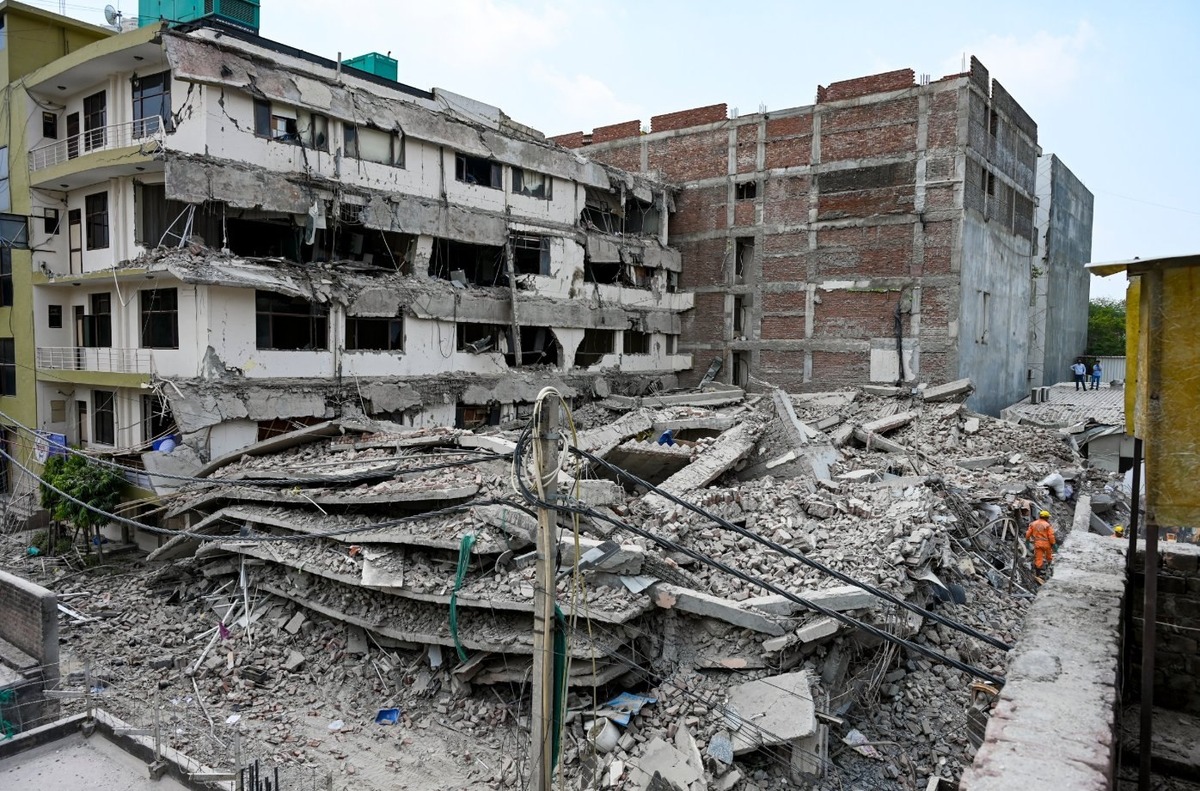
Parvati was still on the floor, covered in flour and flattened tin.
The Victims — Students Who Came to Delhi for a Future
Five of the six dead were students. The sixth was Parvati Ojha, the canteen owner.
Ravi Prakash, 26, from Gonda, Uttar Pradesh. He had completed MBBS in Kyrgyzstan and was preparing for the Foreign Medical Graduate (FMG) examination. Eldest of five siblings. His father is a farmer.
“His father is a farmer, and the family was hoping that he would become a doctor,” his uncle Jaiprakash told The Indian Express.
Nalin, 22, from Nalanda, Bihar. Son of a farmer. Had moved to Delhi just six months ago to prepare for the Graduate Aptitude Test in Engineering (GATE).
Ekta, a medical student from Alwar, Rajasthan. Her father Ramesh Chand reached Delhi from Alwar after hearing the news. “Yesterday afternoon, we spoke on the phone for about 17-18 minutes,” he told reporters at the site. “She also spoke with her mother and brother. She would call home around 7:30 pm as part of her daily routine. She didn’t call last night.”
Alok Verma and Kapil Lohaniya — both GATE aspirants. Both dead.
Twelve others were injured, pulled from the debris through the night by NDRF teams using hydraulic cutters, JCBs, rotavators, victim-location cameras, and sniffer dogs.
The March Complaint That Was Ignored
The building did not simply collapse. It had been leaning for weeks.
Abdul Sakir, a tenant living in the neighbouring building, told The Hindu that he had filed a formal complaint with both the Delhi Police and the Municipal Corporation of Delhi (MCD) in March — two months before the collapse. His complaint was specific: the building next door was visibly tilting. This was not a vague fear. It was a measurable, documented structural defect reported by a resident who watched the building change shape.
“Earlier, there were only three floors. This year, two more floors were added and the construction of the sixth floor was going on,” Sakir told The Hindu. “But no action was taken.”
When the MCD and the police both failed to act, Sakir escalated — filing a writ petition in the Delhi High Court through a lawyer. The petition stated that the neighbouring building was tilting dangerously and that the MCD was not taking any action.
At this point, the MCD told the High Court that construction had been stopped.
“We saw construction taking place even after that,” said Anand Kumar, another resident, to The Hindu.
In other words: the MCD submitted a representation to the court that was directly contradicted by observable reality. Construction on the upper floors — the illegal fourth, fifth, sixth floors — continued in plain sight.
The System Behind the Collapse
The pattern is not new. It has a name and a history.
In the first five months of 2026 alone, Delhi Fire Services received 76 calls related to building collapses. In 2025, there were 544 such calls. In 2024, 464. Between January 2024 and December 2025, 46 people died in building collapses in Delhi.
The most infamous precedent is the 2010 Lalita Park disaster in East Delhi, where a five-storey building collapsed, killing 70 people and injuring 77. Nearly eight years later, the junior engineer held responsible was fined ₹21,000 — roughly what an unauthorised floor rents for in three months.
“The building was originally a three-story structure, and illegal construction of the fourth and fifth floors was underway,” Saurabh Bharadwaj, the Greater Kailash MLA, posted on X after the Saket collapse. “The building had started to tilt. A tenant living in the neighboring building filed a complaint about the leaning structure in March. The complaint was formally submitted to both the police and the municipal corporation, but no action was taken.”
The reason this pattern repeats, say urban planners, is structural — not structural in the engineering sense, but structural in the governance sense.
Jagdish Mamgain, former chairman of the works committee in the unified MCD, told Hindustan Times that Delhi’s collapse crisis stems from unchecked vertical expansion in unauthorised colonies built on weak foundations.
“After the Lalita Park collapse, around 3,000 buildings were surveyed and hundreds were found to have weak foundations built on sandy and moisture-laden soil,” Mamgain said.
“While old illegal structures have repeatedly received protection through regularisation and amnesty measures, new floors continue to be added in connivance with civic officials. In almost every urban village and unauthorised colony, you can find five-, six- and seven-storey buildings standing on rickety foundations.”
Saidulajab, where the collapse occurred, is one such unauthorised colony — developed on agricultural land with no approved layout or building plans.
“There are no approved layout plans or building plans in this area. It is an unauthorised colony that has developed on agricultural land,” a civic official told Hindustan Times.
What Happened After
The collapse triggered the standard script of a tragedy in Delhi’s governance machinery.
The MCD suspended two engineers — Aman Jain (Junior Engineer) and Sudesh Singh Chouhan (Assistant Engineer) from the South Zone — for “non-exercising of effective supervision and slackness.” Delhi Chief Minister Rekha Gupta visited the site, ordered a magisterial inquiry, and promised action against all unauthorised constructions. An FIR was registered under sections for culpable homicide not amounting to murder, negligent conduct regarding construction, and negligent act endangering human life.
The building owner was detained.
But within hours of the official response, an HT visit found that several similar multi-storey buildings nearby were still under active construction. The same area. The same kind of unauthorised colony. The same system humming along as if nothing had happened.
The Number That Should Stop You
The Lalita Park engineer was fined ₹21,000.
Seventy people died.
Seventy is more than the total number of people who died in all 1,008 building collapse calls logged by Delhi Fire Services between January 2024 and May 2026.
And the gap between what the system says and what the system does — the gap between “construction has been stopped” in a High Court affidavit and a tilting building still adding floors — that gap is not a bug. It is the system.
The students who died in Saidulajab did not die because a building fell. They died because a complaint was filed, a writ was petitioned, and at every step — the police, the MCD, the court representation — someone said “it has been handled.”
Parvati was making parathas when it fell. She did not know about the March complaint. She only knew that students came to her canteen every evening, hungry from exams, far from home.


