India’s 7.7% GDP Growth — The Goldilocks Moment Under Threat

It was supposed to be India’s moment.
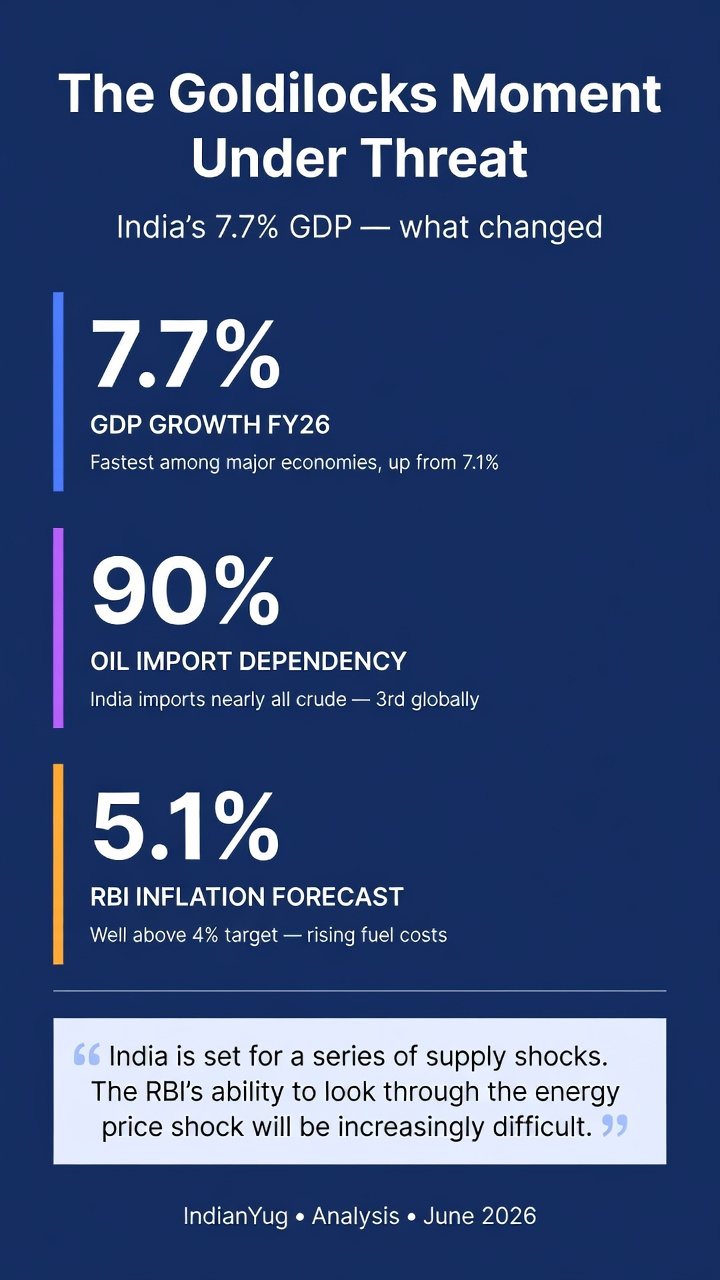
On June 6, the Ministry of Statistics released the final GDP numbers for 2025-26. The Indian economy had grown 7.7% — accelerating from 7.1% the previous year, beating every estimate, and cementing India’s position as the fastest-growing major economy in the world. Real GDP stood at Rs 323.12 lakh crore. Nominal GDP, including inflation, crossed Rs 346 lakh crore.
RBI Governor Sanjay Malhotra had called it, just months earlier, a “rare Goldilocks” phase. Inflation was benign. Growth was steady. The world was looking at India the way investors look at a safe harbour.
Then came February 28.
The oil shock India couldn’t dodge
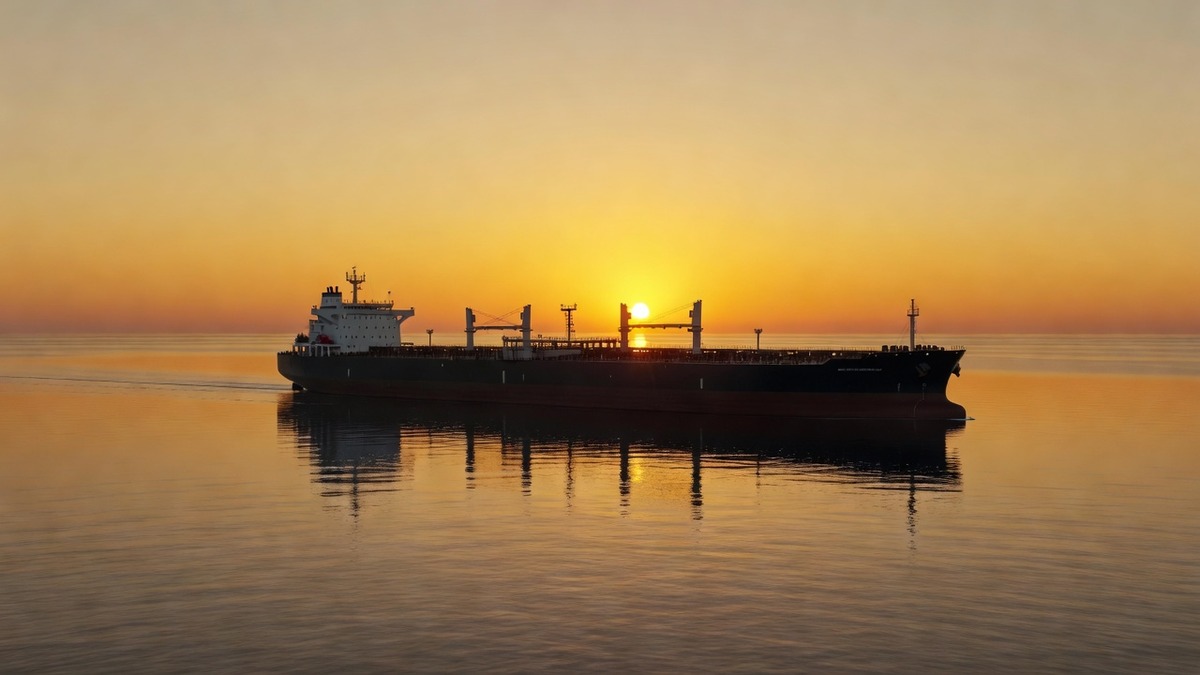
On that day, a US Tomahawk missile struck a school in Minab, southern Iran, killing scores of children. Israeli strikes soon decapitated much of Iran’s leadership. Within 72 hours, Iran closed the Strait of Hormuz — the conduit for 20% of the world’s fossil fuel flows — and declared it would collect tolls.
For India, this was not a geopolitical spectacle happening somewhere far away. India imports roughly 90% of its crude oil. It is the world’s third-largest oil importer and consumer. Every single day, the country spends approximately Rs 5,200 crore on oil imports.
The Strait of Hormuz has now been closed for 14 weeks. Fitch estimates it will not begin reopening until July at the earliest. In that time, Brent crude has averaged $87 per barrel — up from the $70 projected in March, before the war. Some analysts peg the worst-case scenario at $120 to $160 per barrel.
Let that sink in. For an economy that imports nearly all its oil, a sustained $100+ barrel environment is not a headwind. It is a structural shock.
The Goldilocks number that turned heads
But first, the good news — because it is real, and it matters.
India’s 7.7% GDP growth for FY26 was driven by robust private consumption, GST rationalisation that put more money in people’s hands, front-loaded government capital expenditure, and benign inflation that gave the RBI room to support growth. The Q4 print of 7.8% — a five-quarter high — showed momentum was still building as late as March 2026.
High-frequency indicators pointed to sustained economic activity. Inflation was below the lower tolerance threshold. Unemployment was on a declining trajectory. Export performance was improving. The World Bank projected 6.5% growth for 2026. Moody’s said India would remain the fastest-growing G20 economy. The Asian Development Bank lifted its 2025 forecast to 7.2%.
It was, by any measure, a remarkable run.
“The growth momentum further surprised on the upside, with GDP expanding to a six-quarter high in Q2 of 2025-26, reflecting India’s resilience amid persistent global trade uncertainties,” the government said in its official assessment.
But that assessment was written before the war entered its fourth month.
The arithmetic no one wants to do
Here is the problem.
India has delayed raising retail fuel prices even as import costs have mounted. Petrol and diesel prices are up less than 10% since the war began — compared with 50% or more in some other Asian nations. The government has cut taxes on gasoline and gasoil, forgoing roughly 140 billion rupees in revenue every month. It has also said it will not compensate state-run fuel retailers for their losses.
The result: reduced dividends from public sector oil companies, lower fiscal firepower, and a hole in the budget that the government is hoping it can somehow avoid filling.
“The broader effect will reverberate across the economy through higher transport costs, pushing up both food and core inflation,” CRISIL warned.
The government’s fiscal deficit target for FY27 is 4.3% of GDP. But a Reuters poll of economists puts the real number at 4.7%. Some analysts say it could hit 5%.
On June 9, government sources told the press that India would not need additional borrowing this fiscal year despite the rising pressure. The message was clear: we can absorb this. But the markets were not entirely convinced.
The RBI’s impossible choice
On June 5, Reserve Bank of India Governor Sanjay Malhotra announced the MPC’s decision. The repo rate would stay at 5.25%. The stance would remain neutral.
“The adverse implications of the extended disruption in supply chains and elevated energy prices are reflected in the moderation of growth and increase in inflation projections,” Malhotra said.
The numbers told the story. The RBI raised its FY27 inflation forecast to 5.1% — up sharply from the 4.6% projected in April. At the same time, it cut its FY27 GDP growth projection to 6.6%, down from a pre-war baseline that had the economy firing at 7.7%.
This is the central bank’s impossible choice. If it raises rates to contain inflation — now running well above the 4% target — it risks strangling growth. If it keeps rates low to support growth, inflation eats into household purchasing power and the rupee takes a further beating.
The market is already pricing in more than 75 basis points of rate hikes over the next year. But the RBI, for now, is holding its nerve — and hoping the war ends before it has to make a choice it cannot walk back from.
The global picture: a darkening backdrop
India’s predicament is not happening in isolation. The global economy is deteriorating alongside it.
Fitch Ratings cut India’s FY27 GDP growth forecast to 6.4% on June 9 — down from 6.7% in March, and nearly 1.3 percentage points below where the economy was running in FY26.
“The oil price shock is hitting world growth prospects and increasing downside risks,” said Brian Coulton, Chief Economist at Fitch. “But we are also amid a very pronounced boom in global spending on IT and that is cushioning the impact on activity in the near term, particularly in Asia.”
Fitch also slashed its global growth forecast for 2026 to 2.4% — down 0.2 percentage points — and revised its average Brent crude estimate to $87 per barrel, up from $70.
In the United States, inflation hit a three-year high of 4.2% in May. Energy prices rose 23.5% year-on-year. Gasoline jumped 40.5%. The Federal Reserve now faces the prospect of having to raise rates in an election year — a politically toxic scenario that would further tighten global financial conditions.
India’s Chief Economic Adviser V. Anantha Nageswaran put it bluntly in an interview on June 9: “The biggest worry is what happens to crude oil prices if the conflict stretches into the second half of the year.”
His assessment of the worst case was stark: if the war drags on, India’s growth rate could fall below 6%. The rupee — already one of the worst-performing Asian currencies since the war began — could cross the 100-to-the-dollar mark. A Frontline analysis published the same day titled its piece “Why India Faces a Dark Economic Winter” and described the coming months as the IMF’s “severe” scenario — global recession, high inflation, and interest rates that stay elevated for longer.
Three shocks, one economy
What makes this moment different from previous oil crises is that the Iran war is not the only shock hitting India.
The conflict has disrupted fertiliser imports at a critical moment, threatening the wheat crop. This comes as an El Niño weather pattern develops, raising the risk of drought. Food inflation — the most politically sensitive form of inflation — is now layered on top of energy inflation.
“The conflict in West Asia is creating challenges for global growth, trade and inflation,” Malhotra acknowledged. The RBI noted that while the economy has so far absorbed the spillover effects with limited disruption, “signs of strain are gradually becoming visible.”
Sat Duhra, Portfolio Manager at Janus Henderson Investors, offered a sobering assessment: “India continues to face deeper structural challenges which has weighed on foreign direct investment, employment, manufacturing expansion, consumption, and nominal GDP growth. The energy shock will undermine growth and pressure government finances. Any move to rein in public-sector capex to stabilise conditions would risk further slowing growth. This leaves policymakers in a difficult position.”
What happens next
India’s Balance of Payments deficit — which stood at $25.2 billion last year — is now expected to balloon to roughly $65 billion in 2026-27, according to HSBC. The RBI has announced a series of measures to attract foreign capital, which could improve the balance by about $30 billion. But the underlying drag persists.
The government’s approach has been measured — almost deliberately so. CEA Nageswaran explicitly compared the current strategy to the early days of COVID-19, when policymakers waited to calibrate the response to the scale and duration of the crisis before deploying large-scale intervention. Additional support, he indicated, can be considered if the situation meaningfully worsens.
But time is not on India’s side. Every week the Strait of Hormuz remains closed, another 10 million barrels of oil are lost to global markets, as per Bloomberg estimates. Global LNG reserves are critically low. Acute energy shortages are expected by September. And India — which imports 90% of its crude — sits at the epicentre of this supply crisis.
The question is not whether India can sustain 7.7% growth. That number is already in the rearview mirror. The question is whether the policy toolkit — fiscal, monetary, and diplomatic — is large enough to prevent the landing from being hard, not soft.
Through the first 100 days of the war, India has held together. Growth is still the envy of the developed world. Inflation, while rising, has not spiralled. The rupee has weakened but not collapsed. The government has not had to go back to the bond market for emergency funding.
But the front half of 2026 was the Goldilocks moment. The back half will determine whether it was a genuine inflection point — or a peak before a long, slow descent.
Sources: Reuters, Reserve Bank of India, Ministry of Statistics and Programme Implementation, Fitch Ratings, BusinessToday, Frontline/The Hindu, CRISIL, HSBC


