Hindu Philosophy and Modern Science Amazing Similarities

The connection between science and philosophy has been there for thousands of years. The scale of the scientific work and the social significance of research have acquired huge proportions.
For example, philosophy and physics were at first organically interconnected, particularly in the work of Galileo, Descartes, Kepler, Newton, Lomonosov, Mendeleyev and Einstein, and generally in the work of all scientists with a broad outlook.
In the same context often overlooked are amazing similarities between implications of theories of modern physics and ancient Hindu philosophy as expressed in the texts of Hindu Philosophy Vedas and Upanishads.
The idea of fundamental reality

We often see numerous objects around us like building, chairs, trees, animals and it becomes a part of our everyday reality. However, the fact that has been established by science is that the world is not made out of rigid firm objects like building.
At the atomic and sub-atomic level it consists of fuzzy wavelike objects and lot of empty space. So the solid nature of objects we see around is only apparent. As one goes deeper and deeper, one keeps on finding vacuum all the way.
For example, a hydrogen atom is about 99.9999999999996% empty space. Put another way, if a hydrogen atom were the size of the earth, the proton at its center would be about 200 meters (600 feet) across.
The Hindu Philosophy says that the ideas of sunyata and Maya or illusion covering the whole universe, as Adi Shankaracharya said “Brahma Satyam, Jagat Mithya”,Brahman is the only truth; the world is a false illusion.
Now, just like us, he must have seen solid bodies, rigid walls and trees.
Thus, because of the covering of Maya, one does not see the underlying real Brahman. (Previously, the concept of Maya from Mandukya Upanishad was emphasized by Shankaracharya’s spiritual grandfather Gaudapadacharya).
Similarly, in physics, one sees only the material objects around and does not see
Moreover, as per modern physics, particles are believed to be in some kind of suspended state devoid of any specific properties until they are measured.
They are in some sense both here and there at the same time and are described by a wave function, a superposition of seemingly contradictory properties.
Amazingly, the description is very similar to the description of Brahman e.g. in Ishopanishad: “It moves and it moves not; it is far and it is near; it is within all this and it is also outside all this.”
Quantum Entanglement
One of the ultimate shocks in modern physics came from the quantum theory when Bell’s theorem and subsequent experiments proved the so-called entanglements to be right.
Quantum entanglement is a quantum mechanical phenomenon in which the quantum states of two or more objects have to be described with reference to each other, even though the individual objects may be spatially separated.
This leads to correlations between observable physical properties of the systems.
For example, it is possible to prepare two particles in a single quantum state such that when one is observed to be spin-up, the other one will always be observed to be spin-down and vice versa, this despite the fact that it is impossible to predict, according to quantum mechanics, which set of measurements will be observed.
These developments are the most important developments in the history of physics and perhaps in the whole of science.
They give rise to the idea of the interconnected wholeness of the world and non-local interactions in contrast to the separate identities with local interactions.
Thus atoms also exhibit holistic like properties and perhaps some primitive relationship to consciousness.
So it is not proper to say that any analysis starting with atoms is reductionist and not holistic. The four Mahavakyas express a similar concept about individual and Brahman.
Pragnanam Brahman – “Consciousness is Brahman” (Aitareya Upanishad 3.3 of the Rig Veda) Ayam Atma Brahman – “This Self (Atman) is Brahman” (Mandukya Upanishad 1.2 of the Atharva Veda) Tat Tvam Asi – “That Thou art ” (Chandogya Upanishad 6.8.7 of the Sama Veda) Aham Brahmasmi– “I am Brahman” (Brhadaranyaka Upanishad 1.4.10 of the Yajur Veda). Thus Brahman is present in everything.
This matches very well with the concept of modern physics that everything is made out of the same fundamental particles.
Observer effect in Quantum Mechanics
Another basic finding of quantum theory is the involvement of the observer in the observed things.
It is impossible to separate the effect of the measuring apparatus from the object measured.
The detachment of the two is just not possible.
Such an idea about the observer and the object of observation is also emphasized in Upanishads. It is behind the holistic philosophy about mind and body.
Origin of Universe
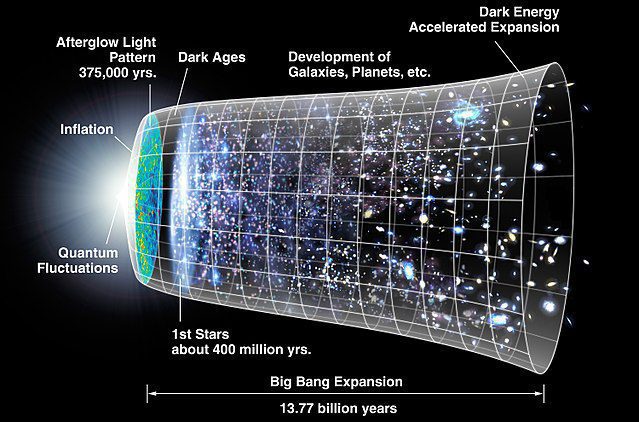
The current model of the origin of the universe assumes that there was a total vacuum in the beginning and the universe arose from a quantum fluctuation.
In this way, something came out of nothing. At that time it was totally dark since the light had not emerged from vacuum yet!
Now compare this model with the following quotation from Vayupuran about the origin of the universe.
“In the beginning, there was nothing in the universe. The Brahman (the divine essence) alone was everywhere.
The Brahman had neither color nor scent; it could not be felt or touched. It had no origin, no beginning or no end.
The Brahman was constant and it was the origin of everything that was destined to be in the universe and the universe was shrouded in darkness. ” Nasadiya Sukta (story of creation) also mentions that there was total darkness before creation.
Theory of Relativity
One of the most famous theories of modern science by Albert Einstein, the theory of relativity had some revolutionary concepts too.
It requires that measurement of time depends on the observer’s motion and also the strength of the gravitational field he/she is in.
An often recurring mention in Hindu scriptures is that Brahma’s time is different from ours.
When one hears about Arjun looking at the past, present and future in the mouth of Lord Krishna in Vishwaroop Darshan (Ch.11 of Bhagvatgeeta), one is reminded of
Also, it is well known that in Hinduism, sages came up with the correct order of magnitude of the age of the universe of several billion years when other religious systems insisted on the age to be a few thousand years.
Bell’s equality and concept of Brahman in Hinduism

As an example of a violation of conventional logic, let us take up a hypothetical situation.
Consider a simple logical inference such as: if in a roomful of 100 people, 40 have brown hair, then 60 do not have brown hair.
Bell’s inequalities are based on such logical statements when applied to quantum objects. They are violated by experimental results on atomic systems.
In its simplest form, Bell’s theorem states:[
No physical theory of local hidden variables can ever reproduce all of the predictions of quantum mechanics.
Conclusions from quantum theory agree with the experiments.
Such a situation would correspond to Upanishad’s idea that Brahman cannot be understood by logic! If it can be understood, it is not Brahman!
There is a story about two yogis. One meditated all day.
The other one read scriptures all day. At the end of every
The first yogi asked him with astonishment as to what suddenly happened. “Now you understand everything suddenly!” The second yogi replied “I now understand that this cannot be understood!”


