RBI to Transfer Record ₹3 Lakh Crore to Government: What It Means for India’s Economy

The Reserve Bank of India (RBI) is set to announce yet another record surplus transfer to the central government this week.
When its board meets on May 22, 2026, economists expect a payout of ₹3 lakh crore (approximately ₹3 trillion) — with some estimates stretching as high as ₹3.4 lakh crore.
This would be the third consecutive year of record-breaking transfers, following ₹2.69 lakh crore in FY25 and ₹2.11 lakh crore in FY24.
What Is the RBI Surplus? And How Does It Work?
Unlike a company that pays dividends to shareholders, the RBI — nationalised in 1949 — transfers its surplus to the government under Section 47 of the Reserve Bank of India Act, 1934.
The provision states: “After making provision for bad and doubtful debts, depreciation in assets, contributions to staff and superannuation fund… the balance of the profits shall be paid to the Central Government.”
The RBI generates income from three primary sources:
- Seigniorage — the profit between the face value of currency notes and the cost of printing them.
- Interest income — from lending to the central government, state governments, and commercial banks.
- Investment returns — earnings from foreign currency assets (US Treasury bonds, etc.) and gains from exchange rate fluctuations.
This is not a discretionary payment. The quantum is determined by a structured framework — the Economic Capital Framework (ECF) — revised most recently in May 2025, which balances the RBI’s own risk buffers against what can be transferred to the government.
Under this framework, the Contingent Risk Buffer (CRB) must be maintained between 4.5% and 7.5% of the RBI’s balance sheet.
How Many Times Has This Happened? UPA vs. Modi Government
The RBI has transferred surplus to the government every year since the law came into effect. But the scale has changed dramatically over the past decade.
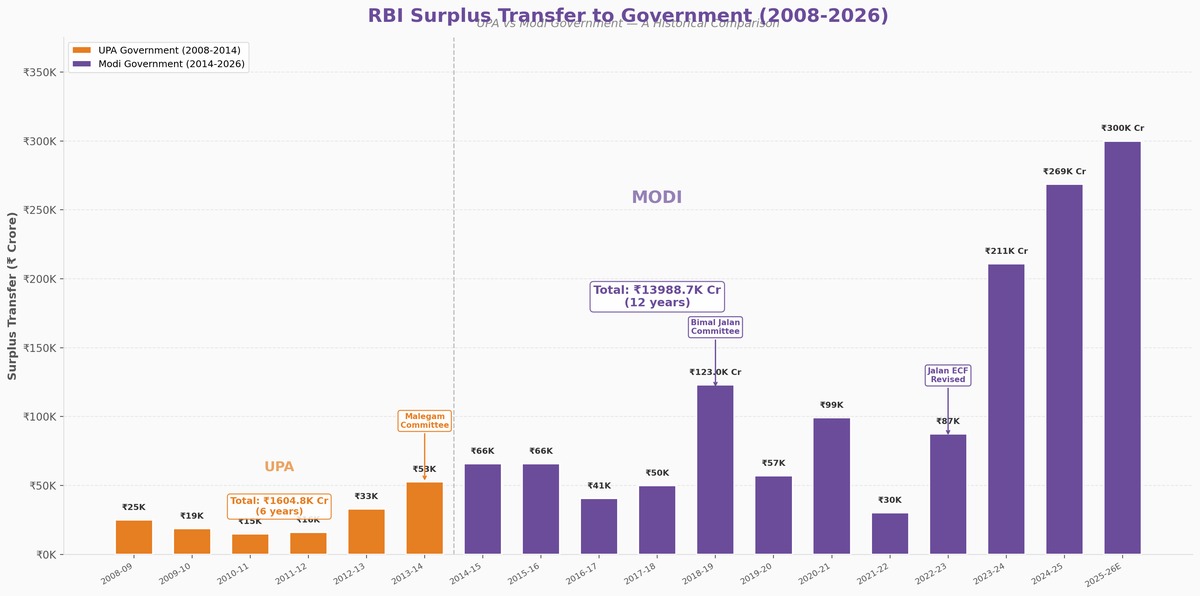
Here is a year-wise comparison based on official government data (PIB) and RBI annual reports.
Under the UPA Government (2008–2014)
During the six years of the UPA regime for which official data is available, surplus transfers averaged roughly ₹27,000 crore per year.
- 2008-09: ₹25,009 crore
- 2009-10: ₹18,759 crore
- 2010-11: ₹15,009 crore
- 2011-12: ₹16,010 crore
- 2012-13: ₹33,010 crore
- 2013-14: ₹52,679 crore
Total (6 years): ~₹1.6 lakh crore
The jump in 2013-14 followed the Y.H. Malegam Committee recommendations, which concluded the RBI was holding excess reserves. Post-2013, the share of surplus transferred to the government jumped from 53.4% to nearly 100%.
Under the Modi Government (2014–2026)
The first five years of the Modi government saw moderate transfers — averaging around ₹55,000 crore annually — before the numbers began to climb sharply in the second term.
- 2014-15: ₹65,896 crore
- 2015-16: ₹65,876 crore
- 2016-17: ₹40,659 crore
- 2017-18: ₹50,000 crore
- 2018-19: ~₹1.23 lakh crore
- 2019-20: ₹57,128 crore
- 2020-21: ₹99,122 crore
- 2021-22: ₹30,307 crore
- 2022-23: ₹87,416 crore
- 2023-24: ₹2,10,878 crore (₹2.11 lakh crore)
- 2024-25: ₹2,68,590 crore (₹2.69 lakh crore)
- 2025-26 (expected): ~₹3,00,000 crore
Total (12 years): ~₹11.3 lakh crore — nearly 7 times what was transferred in the previous six years.
In fact, the last three years alone (FY2023–2026) account for over ₹5.66 lakh crore — more than 3.5 times the total transferred during the entire six-year UPA period.
A 20-year perspective puts this in even sharper relief. According to data compiled by the Pahle India Foundation, RBI surplus transfers grew by a staggering 4,873% — from just ₹5,400 crore in 2004-05 to ₹2,68,590 crore in 2024-25.
What Is Driving This Year’s Record Transfer?
Three factors explain why the RBI’s surplus has ballooned to unprecedented levels.
1. Massive Forex Gains
The RBI’s foreign exchange operations have become its single biggest profit centre. In FY25, the RBI sold a record $398.7 billion — more than double the previous year’s $153 billion.
These dollars were originally purchased at an average cost of ₹68.4. As the rupee depreciated, the RBI booked enormous gains: an estimated ₹1.73 lakh crore from forex operations alone in FY25.
For FY26 (the year ending March 2026), the picture is even more favourable.
The US dollar fell nearly 10% against a basket of major currencies, and gold prices surged 60%.
Both factors significantly improved the RBI’s accounting profitability, supporting a higher surplus transfer.
2. Higher Interest Income
The RBI earns interest on its holdings of domestic and foreign government securities.
With global interest rates remaining elevated through most of FY26, returns on the RBI’s investment portfolio have been strong.
3. Wider CRB Band Gives More Flexibility
The revised Economic Capital Framework (approved in May 2025) widened the Contingent Risk Buffer range from 5.5%–6.5% to 4.5%–7.5%.
While the RBI has opted to keep provisioning at the higher end (7.5%) this year, given global uncertainty, the wider band gives more room to manoeuvre.
If the RBI ever needs to provision less, the surplus available for transfer rises even further.
How Does It Matter for India’s Economy?
A ₹3 lakh crore surplus is not pocket change. Here is what it means in practical terms:
- Fiscal Deficit Relief: The transfer represents roughly 0.8% of GDP. It directly reduces the government’s fiscal deficit, helping New Delhi inch closer to the FRBM target of 3% of GDP. The government has budgeted for a fiscal deficit of around 4.5% for FY26-27 — this windfall could shave off ~20 basis points.
- Lower Borrowing Pressure: Every rupee the government receives from the RBI is a rupee it does not need to borrow from the market. This reduces pressure on bond yields, lowers the government’s interest burden, and frees up capital for private borrowers.
- Cushion Against Global Shocks: This surplus arrives at a time when crude oil prices are rising due to Middle East tensions, the rupee is under pressure, and foreign portfolio investors have turned net sellers. The extra fiscal room allows the government to absorb these shocks without resorting to tax hikes or spending cuts.
- Non-Tax Revenue Boost: Dividend and surplus transfers fall under non-tax revenue. The government’s budget for FY26-27 estimated ₹3.16 lakh crore from dividends and surpluses (RBI + PSBs + FIs combined). The RBI alone delivering ₹3 lakh crore means the overall non-tax revenue target of ₹6.66 lakh crore could be comfortably met or exceeded.
- No Impact on Inflation: Unlike printing money (which fuels inflation), the surplus transfer represents real profits already earned by the RBI. It does not increase the money supply or stoke demand-pull inflation.
What Can the Government Do With This Money?
The government has three broad paths:
Option 1 — Fiscal Consolidation: Use the windfall to reduce the fiscal deficit faster than planned. This would improve India’s credit rating outlook and signal fiscal discipline to global markets. Bond markets would respond positively, lowering yields further.
Option 2 — Boost Capital Expenditure: The extra funds could be deployed toward infrastructure — highways, railways, defence, and green energy projects. India’s capex push has been the centrepiece of recent budgets, and this would give it additional firepower without adding to borrowings.
Option 3 — Welfare and Subsidies: With rising crude oil prices increasing the burden of fuel subsidies and food inflation hitting vulnerable households, the government may choose to expand social welfare programmes or provide targeted relief. This would be the politically expedient choice in an election-heavy year.
Most analysts expect a combination of Options 1 and 2 — a partial deficit reduction coupled with higher capex.
The Controversy Around RBI Independence
It would be incomplete to discuss RBI surplus transfers without acknowledging the heated debate surrounding them. In 2018, the relationship between the government and the RBI hit a low point.
Then-RBI Deputy Governor Viral Acharya famously warned that governments undermining central bank independence would “come to rue the day.”
Former Finance Secretary Subhash Chandra Garg’s book recounts then-Prime Minister Modi telling RBI Governor Urjit Patel that he was like a “snake who sits over a hoard of money.” Both Acharya and Patel resigned soon after.
The matter was resolved with the Bimal Jalan Committee formula (2019), which institutionalised the surplus transfer framework and removed ad hoc decision-making.
The revised ECF in May 2025 further strengthened this structure by widening the risk buffer band, giving the RBI more flexibility while maintaining its autonomy.
Critics argue that such large transfers could make governments dependent on a fiscal crutch rather than pursuing genuine tax reform.
The Governance Now analysis put it well: “There is a real risk that governments may come to view these transfers as a fiscal crutch, rather than a windfall that should be used judiciously.”
What Happens Next?
The RBI board meets on Friday, May 22, 2026, to finalise the surplus transfer for FY26. The market has already priced in a payout of around ₹3 lakh crore.
If the number comes in meaningfully higher — say ₹3.4 lakh crore — bond markets could see a positive repricing.
However, analysts caution that forex gains are inherently volatile. Puneet Pal, head of fixed income at PGIM India Asset Management, notes that while the dividend provides short-term fiscal comfort, it does not change the structural story.
If crude prices remain elevated for a prolonged period, even a ₹3 lakh crore transfer cannot fully offset the macro pressure.
For the common citizen, the significance is simple: a record RBI surplus means the government has more money to spend without borrowing more or taxing more.
Whether that money goes toward better roads, lower deficits, or subsidised food will determine how much of this windfall actually reaches your pocket.
Key Takeaways
- RBI expected to transfer ~₹3 lakh crore to the government — a record for the third year running.
- Under the Modi government (2014–2026), total surplus transfers have reached ~₹11.3 lakh crore — nearly 7x the UPA-era total of ~₹1.6 lakh crore.
- The record is driven by massive forex gains (RBI sold $398.7 billion in FY25), a favourable interest rate environment, and a revised ECF framework that balances risk buffers with surplus distribution.
- The transfer provides a fiscal cushion of ~0.8% of GDP at a time when crude prices and global uncertainty are rising.
- The money can be used for deficit reduction, infrastructure spending, or welfare — without increasing taxes or market borrowings.


