The Real Cost of India’s Fuel Crisis-What Two Price Hikes in One Week Mean for You

You filled your petrol tank last week. It hurt. You are filling it again today. It hurts even more.
In just one week, petrol and diesel prices have gone up twice. On May 15, the government allowed oil companies to hike prices by ₹3 per litre. Then, on May 19, another hike of 87 to 96 paise per litre came. Two hikes. Seven days. Your pocket is feeling the squeeze.
Right now, in Delhi, one litre of petrol costs ₹98.64. Diesel is at ₹91.58. In Kolkata, petrol has crossed ₹109.70. In Mumbai, you pay ₹107.59 for a litre of petrol. Every Indian who owns a vehicle, takes a taxi, or buys vegetables is feeling this crisis.
But here is the real question. Why is this happening? And what does it mean for you and your family?
Let us break it down in simple terms.
The Raw Numbers: What Actually Happened
Let us look at the facts first.
On May 15, oil marketing companies — IOC, BPCL, and HPCL — raised petrol and diesel prices by ₹3 per litre across all major cities. Before this hike, Delhi petrol was at ₹94.77. After the hike, it jumped to ₹97.77.
Then came May 19. Another hike of 87 to 96 paise per litre. Delhi petrol is now at ₹98.64. Diesel in Delhi is at ₹91.58.
City-wise prices (May 19, 2026):
- Delhi — Petrol ₹98.64/L, Diesel ₹91.58/L
- Mumbai — Petrol ₹107.59/L, Diesel ₹94.08/L
- Kolkata — Petrol ₹109.70/L, Diesel ₹96.07/L
- Chennai — Petrol ₹104.49/L, Diesel ₹96.11/L
These numbers are not just numbers. They decide how much you pay for your morning commute. They decide how much your auto-rickshaw driver takes home at night. They decide the price of the milk your child drinks.
But here is something even more shocking. Before the May 15 hike, the oil marketing companies were losing ₹750 crore every single day. The ₹3 hike on May 15 only reduced those losses by about 25%. That means OMCs are still bleeding money. And that means more hikes are coming.
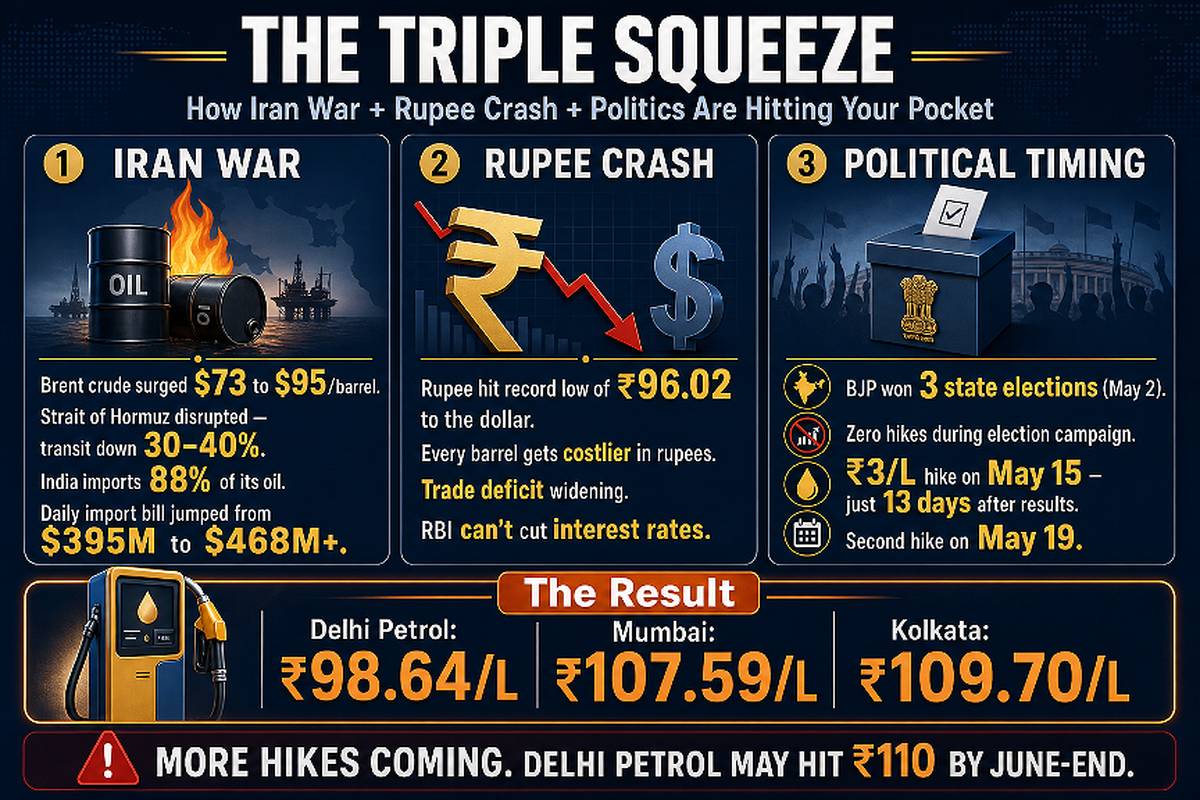
The Triple Squeeze
How the Iran War, the Rupee Crash, and Political Timing Are Squeezing Every Indian
Why Now? The Iran War and Crude Oil
You might be wondering — why did prices stay stable for months and then suddenly jump twice in one week?
The answer lies far away from India. In West Asia.
The conflict between Iran and Israel has escalated badly. The Strait of Hormuz — a narrow strip of water through which a huge amount of the world’s oil passes — has been disrupted. Ship traffic through the strait has dropped by 30 to 40 percent. Insurance rates for oil tankers have shot up by 500 percent.
When oil cannot move freely, its price goes up. Brent crude — the international benchmark for oil prices — has surged from about $73 per barrel in April to between $88 and $95 per barrel today.
India imports 88 percent of its crude oil needs. So when global prices go up, we have to pay more.
Before the crisis, India’s daily oil import bill was around $395 million. Now it has jumped to over $468 million every single day. That is $73 million extra leaving the country daily.
Oil marketing companies tried to absorb these higher costs for a while. But they cannot do it forever. Eventually, they have to pass the burden to you.
The Political Timing: A Story of Two Faces
Now, let us talk about something that has made many Indians angry.
The state election results for Assam, West Bengal, Kerala, Tamil Nadu, and Puducherry were declared on May 2. The BJP/NDA won 3 of these 5 states.
During the election campaign period — throughout April and early May — there were no fuel price hikes. Absolutely none. Even though crude oil prices were already rising, the government did not allow OMCs to increase rates. Why? Because elections were on. Price hikes would have cost votes.
But the results were declared on May 2. And just 13 days later, on May 15, the first major hike came. Then again, on May 19, less than a week after the first one.
The opposition is calling this “election fraud on voters.” They say the government deliberately kept prices low during elections and then pounced on people right after winning.
Government sources are now saying more hikes will come. They use the word “gradually.” But for a family already struggling with monthly expenses, gradual is still painful.
The Rupee Crunch: When Your Money Loses Value
There is another big reason fuel is getting expensive. The Indian rupee is in trouble.
The rupee recently hit a record low of ₹96.02 against the US dollar. That means every dollar now costs you more rupees than ever before.
Oil is bought and sold in dollars on the global market. When the rupee weakens, every barrel of oil becomes more expensive in rupee terms.
But here is the double blow. Global oil prices are rising AND the rupee is falling. Both things are happening at the same time.
This also widens India’s trade deficit. We are spending more dollars to buy oil, but we are not earning enough dollars from exports to balance it out.
There is another problem. The Reserve Bank of India (RBI) wants to control inflation. Fuel prices push up the cost of everything. So the RBI cannot cut interest rates easily. That means your home loan and car loan EMIs stay high.
Who Gets Hit the Hardest
Every Indian is affected. But some are hit much harder than others.
Auto-rickshaw drivers: Their net incomes have dropped by 30 to 40 percent. They spend hours on the road every day, but a bigger chunk of their earnings now goes into the fuel tank.
Truckers: Diesel makes up 60 to 70 percent of their total operating costs. For every ₹1 increase in diesel prices, a long-haul truck owner has to spend ₹10,000 to ₹15,000 more per year.
Middle-class commuters: Monthly fuel bills have gone up by 15 to 20 percent compared to last year. That is money you cannot spend on your children’s education, weekends out, or savings.
Food prices: Diesel moves everything. Milk prices are already up by 12 percent. Vegetables are getting costlier every week. The fuel price hike will show up on your kitchen plate within days.
LPG users: A standard 14.2 kg LPG cylinder now costs around ₹803 in Delhi. In rural areas, many poor families are switching back to wood and dung cakes for cooking. All the progress made in clean cooking fuel is being reversed.
Your auto ride costs more. Your grocery bill is higher. Your milk is pricier. Your cooking gas is a burden. This is the real cost of the fuel crisis.
Where Are We Headed
The bad news is that this is probably not over.
Government sources have confirmed that “gradual further hikes” will continue.
If Brent crude stays above $90 per barrel and the rupee remains near ₹96 to the dollar, experts estimate another ₹2 to ₹3 per litre hike by the end of May. That means in May alone, prices could go up by ₹5 to ₹6 per litre.
At this rate, Delhi petrol could hit ₹110 per litre by the end of June. That seemed unthinkable a year ago. Now it looks likely.
The only thing that could bring relief is if the Iran-Israel conflict de-escalates. If the Strait of Hormuz reopens fully. If global crude prices fall. But none of that is happening right now.
It Is Not Just About Fuel
This is not just about what you pay at the petrol pump. It is about everything.
It is about the ₹10 extra that your auto driver asks for because fuel is expensive. It is about the rising price of vegetables at your local mandi. It is about the LPG cylinder that makes you think twice before cooking a big meal. It is about the family trip you canceled because the fuel budget is blown.
Fuel touches everything. It moves your world. And when its price goes up, every part of your life becomes more expensive.
Understanding why this is happening does not make the pain go away. But it helps you prepare. It helps you ask the right questions. It helps you make sense of why your money does not go as far as it used to.
Two price hikes in one week. More coming. The real cost of India’s fuel crisis is not just at the pump. It is in every rupee you spend.


